John Wayne Gacy House: Location, Haunted History & What’s There Now
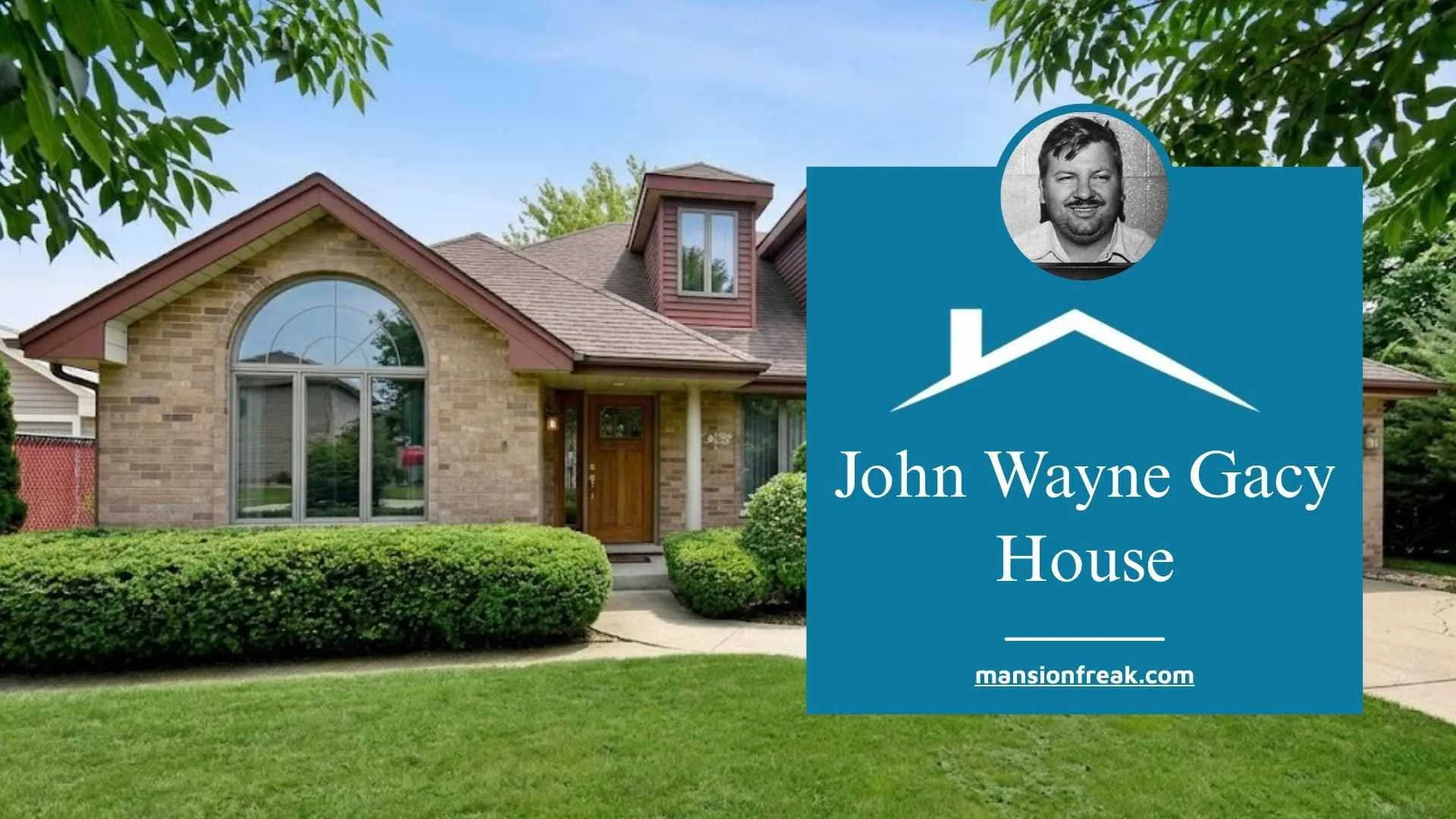
John Wayne Gacy’s journey from a seemingly ordinary suburban contractor to one of America’s most notorious serial killers is grimly reflected in the house where his crimes unfolded. From a nondescript brick ranch at 8213 West Summerdale Avenue in Norwood Park Township, Illinois, to a place permanently etched in true crime history, the John Wayne Gacy house tells a story that is equal parts chilling and deeply tragic.
Behind an unremarkable facade sat a crawl space that would yield the remains of 26 victims, making this property one of the most sinister addresses in American history. Explore more infamous and iconic properties in depth at MansionFreaks, where we unravel the stories behind the walls of history’s most talked-about homes. It’s not just about the houses — it’s about the legacy, the horror, and the truth they represent.
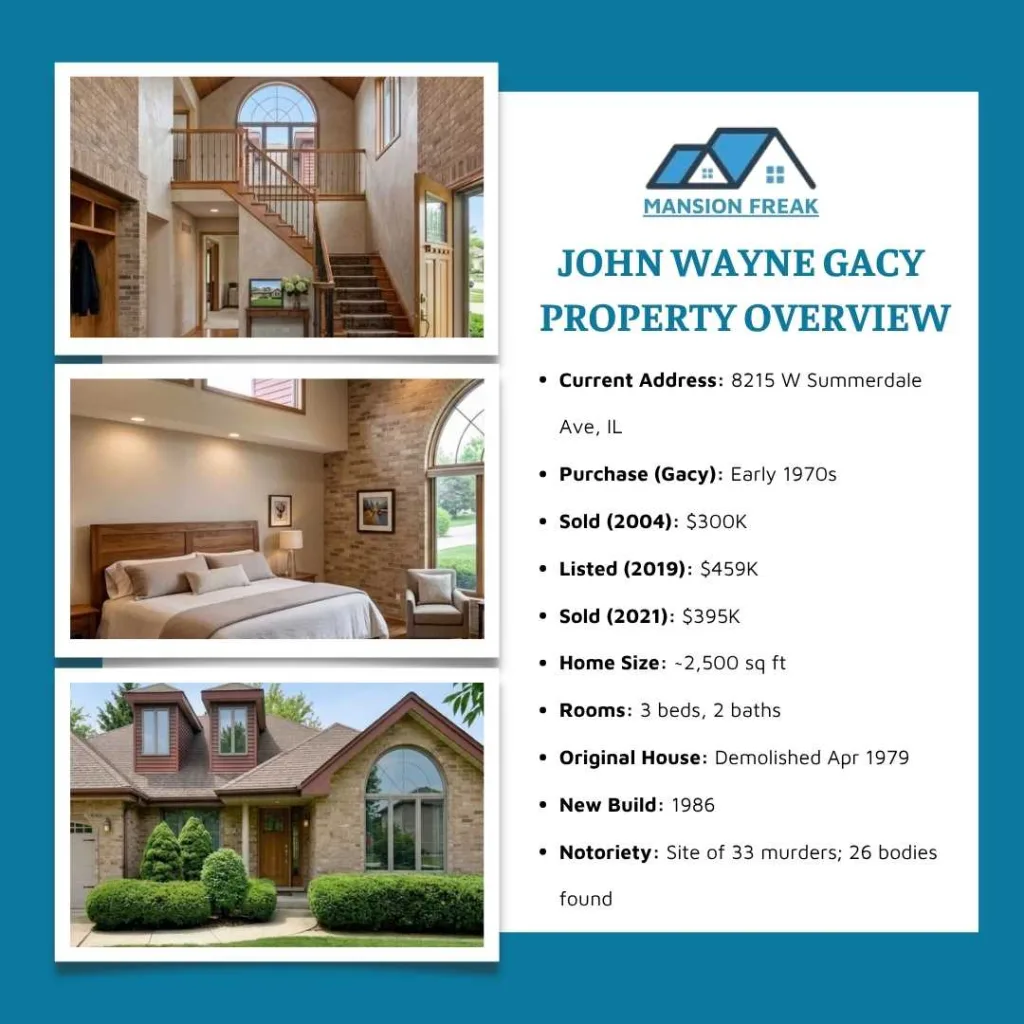
John Wayne Gacy House: Property Details
| Property Detail | Information |
| 📍 Current Address | 8215 West Summerdale Avenue, Norwood Park Township, Illinois |
| 💰 Purchase Price (Gacy) | Bought with financial help from his mother in the early 1970s |
| 💰 Sold (2004) | $300,000 |
| 💰 Listed (2019) | $459,000 |
| 💰 Sold (2021) | $395,000 |
| 🏠 Replacement Home Size | Approx. 2,500 sq ft |
| 🛏️ Rooms | 3 bedrooms, 2 bathrooms |
| 🏗️ Original House Demolished | April 1979 |
| 🏗️ Replacement Home Built | 1986 |
| 🎯 Key Notoriety | Site of 33 murders; 26 bodies recovered from crawl space |
John Wayne Gacy House Location
- Exact Address (Current): 8215 W. Summerdale Avenue, Norwood Park Township, Illinois
- Neighborhood: A quiet, unremarkable residential suburb situated roughly 25 minutes north of downtown Chicago, positioned just east of O’Hare International Airport.
Gacy purchased the property in the early 1970s with financial assistance from his mother. From the street, the original ranch house looked like any other home in the neighborhood — a modest brick structure blending seamlessly into the surrounding suburban landscape. Neighbors described Gacy as a friendly, engaged member of the community who hosted summer parties and worked as a contractor.
A Walk Through the History of the Property
Standing at the edge of this quiet residential street today, it is almost impossible to reconcile the ordinariness of the neighborhood with the magnitude of what occurred here. The surrounding area is lined with modest homes, mature trees, and the kind of stillness you would expect from a working-class Chicago suburb. And yet, this is the street — and very nearly the same lot — where one of the most prolific serial killers in American history carried out his crimes completely undetected for years.
There is something deeply unsettling about that contrast: the grass, the sidewalk, the neighboring driveways all perfectly intact, while beneath what was once this same ground, investigators uncovered 26 bodies in a crawl space in 1978. For anyone who has followed true crime history, the weight of this place is undeniable. For more stories of notorious and historic celebrity and infamous homes, visit the celebrity homes section at MansionFreaks.
John Wayne Gacy House Photos:
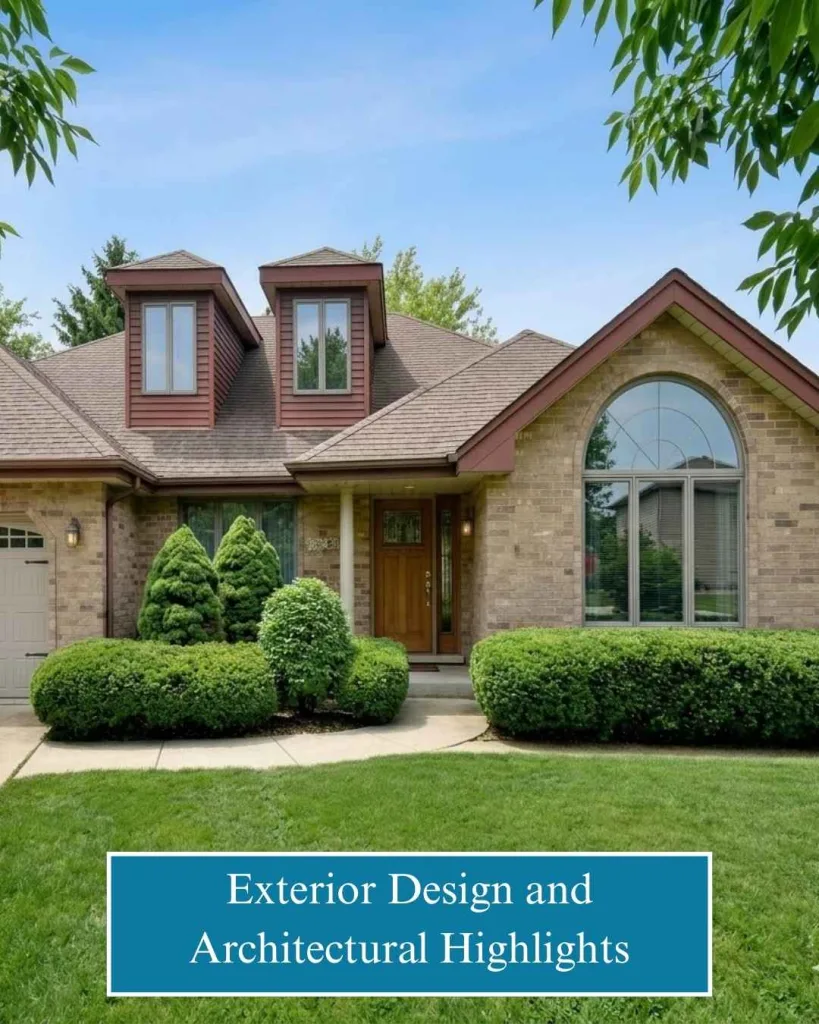


Inside the Original House: What Investigators Found
The original home was a single-story brick ranch. Inside, Gacy had built a tiki bar used for entertaining guests — and targeting victims.
The Crawl Space
The crawl space beneath the main floor became the primary burial site for 26 of Gacy’s 33 victims. Three more were buried on the grounds around the property, and four were found in the nearby Des Plaines River.
The Search Warrant
Police obtained a search warrant in December 1978 after 15-year-old Robert Piest disappeared. Inside, they found multiple driver’s licenses belonging to other men, police badges, and other incriminating materials. Gacy himself drew a diagram to help investigators locate the buried bodies during his confession on December 22, 1978.
Demolition
The house was demolished in April 1979 — four months after Gacy’s arrest — as law enforcement continued recovering remains from the site.
John Wayne Gacy House Haunted: Paranormal Claims and Local Legends
The John Wayne Gacy house haunted reputation has been part of Chicago folklore since demolition. Locals reported unexplained sounds, shadowy figures, and vegetation that refused to grow on the vacant lot for years.
These claims inspired the 2010 found-footage film 8213: Gacy House and Richard Estep’s non-fiction book Gacy’s Ghost. Much like the history-laden Ed and Lorraine Warren house, some addresses carry a psychological weight that no wrecking ball can erase.
John Wayne Gacy House Zillow: Full Sale History
The replacement home at 8215 W. Summerdale Avenue has been listed and sold multiple times, with its dark history consistently affecting buyer interest and final sale prices.
- 1988 — First sale after construction; purchased for parents by a private buyer
- 2004 — Sold for $300,000
- August 2019 — Listed at $459,000; no immediate buyers
- October 2019 — Chicago Sun-Times confirmed the address matched Gacy’s original property; price reduced multiple times
- March 2021 — Sold for $395,000 after nearly two years on the market
According to Zillow data reported at the time, the Cook County Assessor had valued the property at nearly $424,000, meaning the sale came in well below assessed value. The listing made no mention of the home’s history, and the 2021 buyers reportedly learned of the connection only after reporters informed them. The home is described as featuring vaulted ceilings, skylights, a second-floor loft, a double-sided fireplace, an updated kitchen, and a large backyard.
John Wayne Gacy House Now: Who Owns It and What Stands There Today
The property at 8215 West Summerdale Avenue is privately owned and not open to the public. It was last sold in March 2021 for $395,000 and is currently occupied as a private family residence. There is no public marker, memorial plaque, or signage acknowledging what occurred at this address.
Under Illinois law, sellers are not required to disclose deaths on a property, though agents must answer honestly if directly asked by buyers. The investigation into Gacy’s crimes technically remains open — as of the most recent updates, five of his 33 victims remain unidentified, with law enforcement continuing to use DNA advances to work toward naming them. The John Wayne Gacy house may have been replaced, but the case it represents is not yet fully closed.
John Wayne Gacy House Museum: Does One Exist?
No museum exists at the site, and none has ever been established. When the vacant lot was being considered for development in the mid-1980s, at least one person connected to Chicago real estate reportedly advocated for turning it into a memorial for the victims. The idea was rejected in favor of building a new home. The closest publicly accessible resources tied to Gacy’s history are:
- Netflix’s Conversations With a Killer: The John Wayne Gacy Tapes (documentary series)
- Cook County court records from Gacy’s 1980 trial
- Stateville Correctional Center in Crest Hill, Illinois — where Gacy was executed on May 10, 1994
The absence of a museum or memorial remains a point of ongoing discussion among true crime researchers and victim advocates who feel the site deserves a more formal acknowledgment of the 33 lives lost there. For further context on some of the most iconic and notorious homes tied to American history and true crime, the Ira Rennert Hamptons House and similar landmark properties are explored in depth at MansionFreaks.
Who Was John Wayne Gacy?
Born in Chicago on March 17, 1942, Gacy presented a carefully crafted public image throughout the 1970s.

Public Persona
He ran his own construction firm (PDM), performed as “Pogo the Clown” at community events, and regularly hosted neighborhood parties attended by local politicians and up to 400 guests.
The Crimes
Between 1972 and 1978, he murdered 33 young men and boys — luring most with promises of construction work or by impersonating a police officer. He was convicted of all 33 murders on March 13, 1980, the highest number attributed to a single killer in U.S. legal history at the time.
Execution
Gacy was executed by lethal injection at Stateville Correctional Center on May 10, 1994. His reported last words were: “Kiss my ass.”
John Wayne Gacy House Price: Full Property Timeline
| Year | Event | Price |
| Early 1970s | Gacy purchases original ranch house | Not publicly recorded |
| April 1979 | Original house demolished by police | — |
| 1984 | Lot transferred to savings and loan company | — |
| 1986 | New 3-bed/2-bath home constructed; address changed to 8215 | — |
| 1988 | New home first sold | Not publicly recorded |
| 2004 | Property sold | $300,000 |
| August 2019 | Listed for sale | $459,000 |
| March 2021 | Sold to new owners | $395,000 |
Is the John Wayne Gacy House for Sale?
No. As of 2026, the property at 8215 West Summerdale Avenue is privately owned and not listed for sale. The most recent transaction occurred in March 2021, when the home sold for $395,000. The property remains a private family residence, and there are no current indications that it will be listed again in the near future.
Conclusion
The John Wayne Gacy house story is one of hidden evil behind an ordinary door. From a modest Norwood Park ranch to a demolished lot, a renamed address, and a privately owned replacement home, every chapter of this property’s history carries the weight of 33 lives.
The original structure is gone. But five victims remain unidentified, the case remains technically open, and this quiet suburban street will never be just another address. The place has changed. The legacy has not.
Frequently Asked Questions
Where is the John Wayne Gacy house located?
Originally at 8213 West Summerdale Avenue, Norwood Park Township, Illinois. The address was changed to 8215 after the replacement home was built in 1986.
Was the house demolished?
Yes — in April 1979, four months after Gacy’s arrest, as police excavated human remains from the crawl space and surrounding grounds.
Is the John Wayne Gacy house haunted?
Many locals report paranormal experiences near the site. The property’s refusal to grow vegetation after demolition, combined with neighbor accounts of unexplained activity, has made it one of Chicago’s most persistent haunted location legends.
How much did the property sell for?
Most recently $395,000 in March 2021, down from a 2019 listing price of $459,000.
Is there a John Wayne Gacy house museum?
No. The site is a private residence. No official memorial or museum has ever been established there.