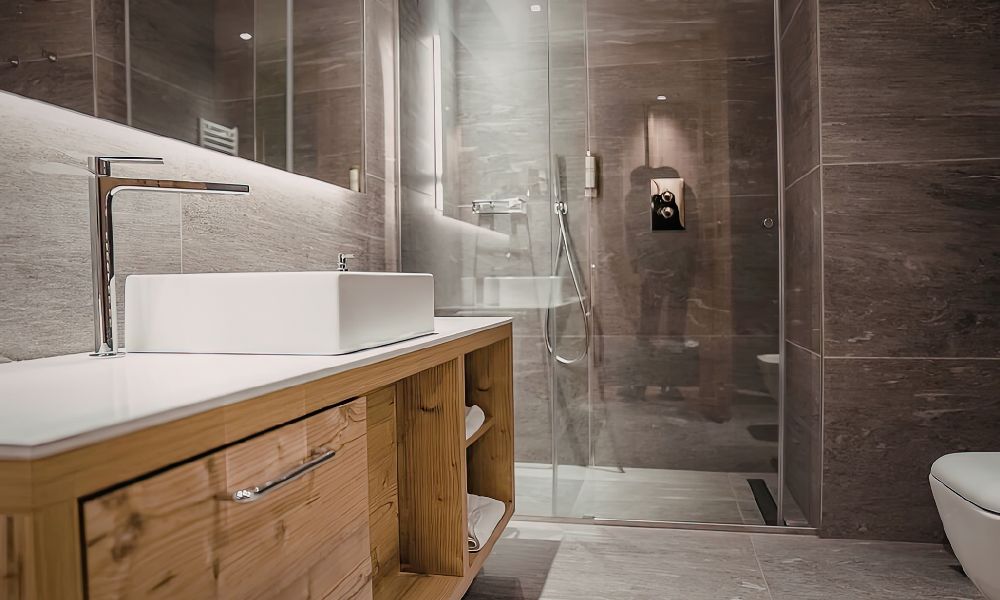
You feel it before you fully register it. Your hand reaches toward the glass and there’s no frame interrupting the motion, no metal cutting the line in half. Just space, light, and water moving through it. Bathrooms used to feel contained, almost boxed in. Now they’re expected to feel open, even a little weightless. That shift didn’t happen by accident. It’s tied closely to how frameless glass shower enclosures reshape the room without changing its footprint.
Visual Transformation of the Space
The biggest change shows up in what’s missing.
Framed showers create edges. Lines that stop your eye, even if you don’t consciously notice them. Remove those, and the entire space starts to read differently.
The shower no longer feels like a separate unit. It blends into the rest of the bathroom. Tile flows uninterrupted. Walls feel longer. Everything connects.
- No bulky frames breaking the visual line
- A seamless look across walls and surfaces
- Finishes stay visible instead of hidden
- The shower becomes part of the overall design
This is how frameless glass showers improve bathroom layouts without touching the structure.
How Glass Improves Light and Space
Light behaves differently once nothing blocks it.
It doesn’t stop at a curtain or frame anymore. It moves across the room, reflecting off surfaces, filling areas that used to sit in shadow.
That shift changes scale. Small bathrooms feel less confined. Larger ones feel more continuous.
There’s also a clarity to it. Fewer visual barriers mean fewer interruptions.
- Light travels freely across the entire space
- Shadows soften instead of collecting in corners
- Sightlines extend beyond the shower area
- The room feels larger without expanding physically
These are the quiet changes that build over time. You don’t always notice them immediately, but you feel them.
Why Designers Prefer Frameless Solutions
Designers lean toward what stays out of the way.
Frameless glass does exactly that. It doesn’t compete with materials or finishes. It lets them carry the visual weight instead.
That flexibility matters. Whether the bathroom leans modern, transitional, or somewhere in between, glass adapts without forcing a specific style.
There’s also the perception factor. Clean, uninterrupted lines tend to read as higher-end, even when the rest of the space is simple.
- Minimal structure that doesn’t overwhelm the design
- Works across different interior styles
- Keeps attention on tile, stone, and lighting
- Creates a refined, modern appearance
This is why glass shower design ideas keep circling back to frameless systems. They simplify without flattening the design.
Where They Work Best
Some spaces change more than others.
Small bathrooms benefit immediately. Removing visual barriers makes the room feel less compressed. The shower stops shrinking the space.
Modern homes already lean toward openness, so frameless glass fits naturally. It reinforces what’s already there.
Renovation projects see the biggest shift. You’re not rebuilding the entire room, but the result feels like you did.
- Small bathrooms that need to feel more open
- Modern interiors that favor clean lines
- Renovations where impact matters more than scale
- Bathrooms with strong finishes that shouldn’t be hidden
These are the situations where the transformation feels most noticeable.
The Detail People Don’t Expect
There’s a small moment that happens after installation.
You stop thinking about the shower as an object.
It’s not something you look at anymore. It’s something you move through. The space feels continuous, not divided.
That’s the real shift. Not just how it looks, but how it’s experienced.
Final Thoughts
Frameless glass shower enclosures change more than appearance. They alter how space, light, and movement work together. By removing visual weight, they open the room without requiring structural changes. That combination is what makes them such a strong design move in modern bathrooms.
FAQ
Do glass showers improve design?
Yes. They create a cleaner, more open look by removing visual barriers and allowing the rest of the bathroom to stand out.
Are they modern?
They align closely with modern design, especially in spaces that prioritize simplicity and openness.
Do they work in small bathrooms?
They’re especially effective in smaller spaces because they make the room feel less confined.
Are they durable?
Frameless enclosures use tempered glass designed for strength and daily use, making them reliable over time.
Are they popular?
Yes. They continue to be a leading choice in both new builds and renovation projects due to their clean appearance and functional benefits.