
Are you trying to figure out whether your household can handle another car payment without cutting into savings or monthly essentials?
Have rising insurance rates, fuel prices, and repair costs started to make your current vehicle feel more expensive than expected?
You might be considering an upgrade or are happy with your current car, so you’re leaning toward a Toyota, Honda, Audi, or Kia lease buyout. If, on top of that, you’re in charge of managing your household budget, you know that vehicle costs don’t stop at monthly payments.
To learn all about planning the ongoing expenses that can follow for years, keep reading.
Source: Magnific
Know the Full Cost of Owning a Car
The vehicle price alone isn’t always the problem. The real pressure usually comes from the costs that show up every month after the purchase.
It’s possible for a car payment to look manageable at first, but insurance increases, fuel expenses, repairs, and registration fees can all add up.
That matters even more today because transportation already takes a large share of household income. We really mean large — housing and transportation made up 50% of household spending in 2024.
For many of those families, that meant less room for savings, groceries, childcare, or emergency expenses.
So, firstly, it helps to break your vehicle costs into two categories: fixed and variable.
Fixed costs are loan payments, insurance, and registration. Variable costs are fuel, maintenance, parking, tires, tolls, and unexpected repairs.
Both affect your monthly budget, but in different ways, and it’s best to track them separately to get a realistic picture of what you can afford.
Use the 20/4/7 Rule Before Taking on a Car Payment
You bought the vehicle, and now that the excitement is gone? It should still fit your budget.
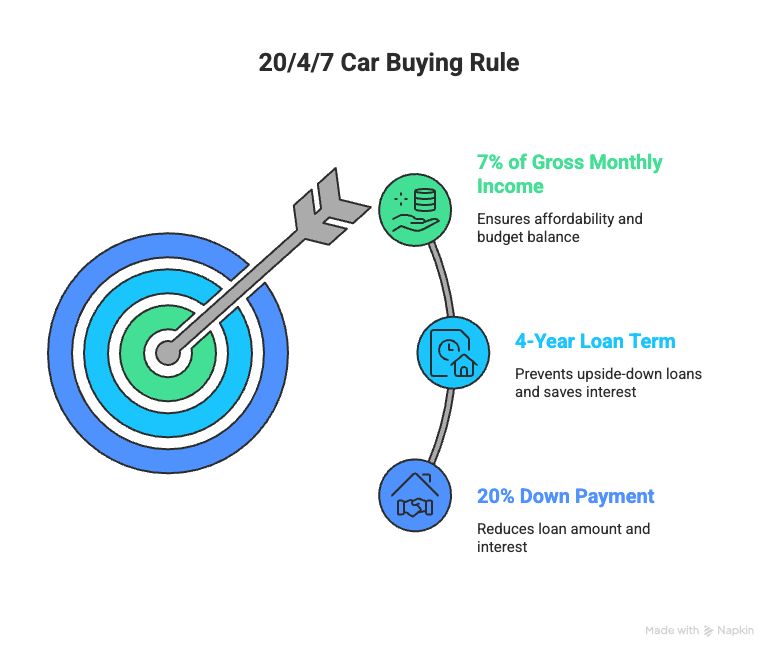
That’s why finance experts recommend the 20/4/7 affordability rule before signing a loan agreement. What does this rule mean?
- ≥20: Your down payment should be at a minimum 20%
- ≤4: Keep your loan term to a maximum of 48 months/4 years
- ≤7: Your monthly car payment shouldn’t exceed 7% of your gross monthly income
You don’t want to end up facing common financing mistakes that put pressure on your budget for a long time. That’s what this rule aims to fix.
A larger down payment lowers the amount you borrow and reduces interest costs over time. A shorter loan term also prevents you from making payments on a car that has already lost a large part of its value.
Many buyers focus only on getting the lowest monthly payment possible. The problem is that longer loan terms often increase the total amount paid by thousands of dollars. They also leave less room in your budget for fuel, insurance, maintenance, and savings.
The ≤7% guideline gives you a limit that keeps transportation costs from taking over the rest of your finances.
Build a Monthly Car Expense Buffer
Even reliable vehicles come with surprise costs; a dead battery, worn tires, brake repairs, failed alternator… It can all throw off your entire monthly budget if you’re not prepared.
Here’s the simple solution: treat car maintenance like a regular household expense instead of an occasional inconvenience. Set aside a fixed amount every month to create a buffer that protects your finances when unexpected repairs show up.
The fund can cover expenses such as:
- oil changes and routine servicing
- tire replacement and wheel alignment
- battery replacement
- brake repairs
- registration renewals
- emergency repairs
Don’t forget about seasonal expenses (many drivers underestimate them). Winter tires, higher fuel usage during colder months, and summer travel costs often increase transportation spending without much warning.
Review Your Household Spending Before Upgrading Your Vehicle
Buying out your lease or buying a new car?
The second can seem reasonable when your current car starts costing more to maintain. Still, it’s important to look at your full household budget before taking on yet another financial commitment.
A car payment, which is rarely low, affects your saving goals, grocery spending, childcare costs, travel plans, and more. What feels affordable during a dealership visit may create pressure later when several bills arrive at once.
If your household already deals with more expenses or existing debt, delaying a vehicle upgrade for another year could be the smartest move.
On the other hand, replacing an unreliable car may save money if repair costs continue to grow every few months.
Lower Ownership Costs Without Giving Up Reliability
The road to reducing vehicle expenses doesn’t always require major lifestyle changes. Sometimes it’s the smallest decisions made consistently that have the biggest impact on your long-term budget.
That’s also why it’s best not to neglect routine maintenance. Drivers who stay on top of oil changes, tire pressure, brake inspections, and fluid checks usually don’t have larger repair bills later.
There’s also insurance shopping. Compare rates once a year to find lower premiums without changing coverage quality.
Your driving habits also affect ownership costs. If you want to keep your vehicle in the best shape possible, forget about aggressive acceleration, hard braking, and excessive speeding, as it all increases fuel usage and places more strain on your vehicle.
Unnecessary trips during the week? Skip them to lower fuel and maintenance expenses over time.
Whatever you decide, make sure you’ve thought it out, as your decisions should fit your income, daily needs, and long-term financial plans.