
Owning a remote property—whether it’s a secluded vacation cabin, a sprawling agricultural farm, a hunting lease, or a residential construction site—is a dream for many. However, that distance from the hustle and bustle of the city comes with a significant vulnerability. When you are miles away for weeks or months at a time, your property becomes a prime target for opportunistic thieves, squatters, and vandals.
The immediate thought for most property owners is to install a security camera. But there is a glaring problem: traditional smart home security systems (like Ring or Nest) are fundamentally crippled outside of suburban environments. They require a constant supply of grid power and a strong, uninterrupted Wi-Fi connection. In the deep woods or on the far edge of a multi-acre estate, these devices are utterly useless.
So, how do you protect an asset when you have absolutely no infrastructure? You pivot from standard home monitoring to advanced, tactical off-grid surveillance.
How to Monitor Outbuildings When Wi-Fi Doesn’t Reach
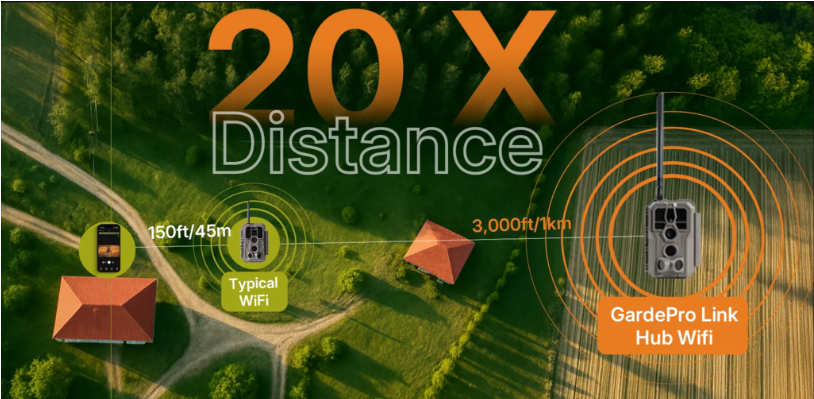
Before diving into completely off-grid solutions, we must address a very common middle-ground scenario: you have an active Wi-Fi router in your main house, but you need to monitor a detached barn, a long driveway gate, or a distant equipment shed where the Wi-Fi signal simply cannot reach. Standard routers drop signal after about 100 feet, leaving your perimeter totally blind.
For this specific challenge, the ultimate solution is a hub-based trail camera system. Instead of forcing the camera to connect directly to your weak home Wi-Fi, this system uses a base station (the hub).
Here is how it works: You plug the hub directly into your home router. The remote security cameras are then deployed out on the property, and they communicate with the indoor hub using dedicated, long-range radio frequencies. This is where groundbreaking innovations like the GardePro Link 1.0 come into play. As the industry’s first-ever trail camera designed specifically to bridge this gap, the Link 1.0 uses a proprietary hub to connect to your home Wi-Fi, allowing it to transmit high-definition media over a staggering distance of up to 3,000ft in an open field.
The greatest advantage of this setup? Because it ultimately piggybacks on your existing home internet via the hub, there is absolutely no cellular subscription required. With a pioneering system like the GardePro Link 1.0, you get the massive, long-range capabilities of an off-grid camera without paying a single cent in monthly data fees. It is, without a doubt, the most cost-effective way to secure large estates, barns, and expansive backyards.
Best Security Cameras for Remote Locations Without Internet (Cellular/4G)
What if your property is entirely disconnected? A hunting cabin in the mountains or a vacant lot simply has no router to plug a hub into. This is where Cellular Trail Cameras become your primary line of defense.
Instead of relying on broadband, these cameras operate exactly like a smartphone. They are equipped with internal SIM cards that ping local cell towers. When the camera’s highly sensitive Passive Infrared (PIR) sensor detects the heat and motion of a trespassing vehicle or person, it wakes up, captures the event, and transmits the photo or video directly to an App on your phone via the 4G network.
This capability transforms your security from a reactive discovery (finding out you were robbed weeks later) into a proactive, real-time intervention. Even if you are sitting in an office three states away, you will receive a push notification within seconds of a perimeter breach, allowing you to immediately dispatch local law enforcement to the scene.
How to Power a Remote Security Camera Without Electricity
A remote security camera is only as good as its power source. If you have to drive three hours every two weeks just to replace a dozen dead AA batteries, the system is doomed to fail. Furthermore, extreme winter temperatures can drain standard alkaline batteries overnight, leaving your property unprotected when you need it most.
To secure a remote property effectively, you must utilize industrial-grade power solutions. Look for surveillance units that feature massive built-in lithium battery packs. Lithium performs exceptionally well in sub-zero freezing conditions and scorching summer heat.
To achieve true “set it and forget it” autonomy, pair these high-capacity internal batteries with a dedicated external solar panel. This combination creates a self-sustaining micro-grid. The solar panel continuously trickle-charges the internal battery during the day, ensuring the camera remains fully powered to guard your property 24/7/365, effectively eliminating maintenance trips.
The Stealth Witness: The Power of 940nm No-Glow IR
A critical flaw in residential security cameras is that they want to be seen. They often utilize bright white spotlights or glowing red infrared LEDs to illuminate the night. While this might scare off a casual teenager, a professional thief or determined squatter will see the glowing red lights in the dark, walk directly up to the camera, and smash it to pieces to destroy the evidence.
To truly secure an unattended property, your surveillance must be invisible. You need to deploy cameras equipped with 940nm No-Glow Infrared technology.
Unlike standard IR flashes that emit a faint red glow, 940nm LEDs operate on a wavelength completely invisible to the human eye. Your camera can capture crisp, high-definition evidence of an intruder in pitch-black darkness without emitting a single visible trace of light. The trespasser will never know they are being recorded, ensuring your security nodes remain hidden and your evidence is successfully gathered.

How to Prevent Vandals from Stealing Your Camera’s SD Card
In the unfortunate event that an intruder manages to spot your hidden camera during the daylight hours, they will likely try to destroy it. If the camera is secured to a tree or post with a heavy-duty steel cable lock and cannot be stolen, the intruder’s next move is entirely predictable: they will pop open the external latch and rip out the SD card to eliminate the photographic evidence.
To close this dangerous security loophole, modern off-grid security strategy demands built-in, embedded storage.
When a camera utilizes embedded storage, the memory is physically soldered onto the internal motherboard, and there is no exposed, removable SD card slot. Even if a vandal smashes the outer casing of the camera, they cannot extract the data. Your recorded 4K evidence remains securely locked deep within the device’s hardware until it finishes transmitting to your cloud network, ensuring the criminal’s identity is preserved for law enforcement.
Conclusion
Securing a remote property no longer requires trenching power lines or negotiating with rural internet service providers. By shifting your mindset toward off-grid tactical hardware, you can build an impenetrable digital fence around your most valuable assets.
Whether you utilize a no-subscription hub system to extend your home Wi-Fi to the edges of your estate, or deploy an invisible, solar-powered cellular matrix to guard a cabin deep in the wilderness, the technology now exists to maintain total control over your property. Equip yourself with the right tools, lock down your perimeter, and enjoy the peace of mind that comes from knowing your remote sanctuary is protected around the clock.