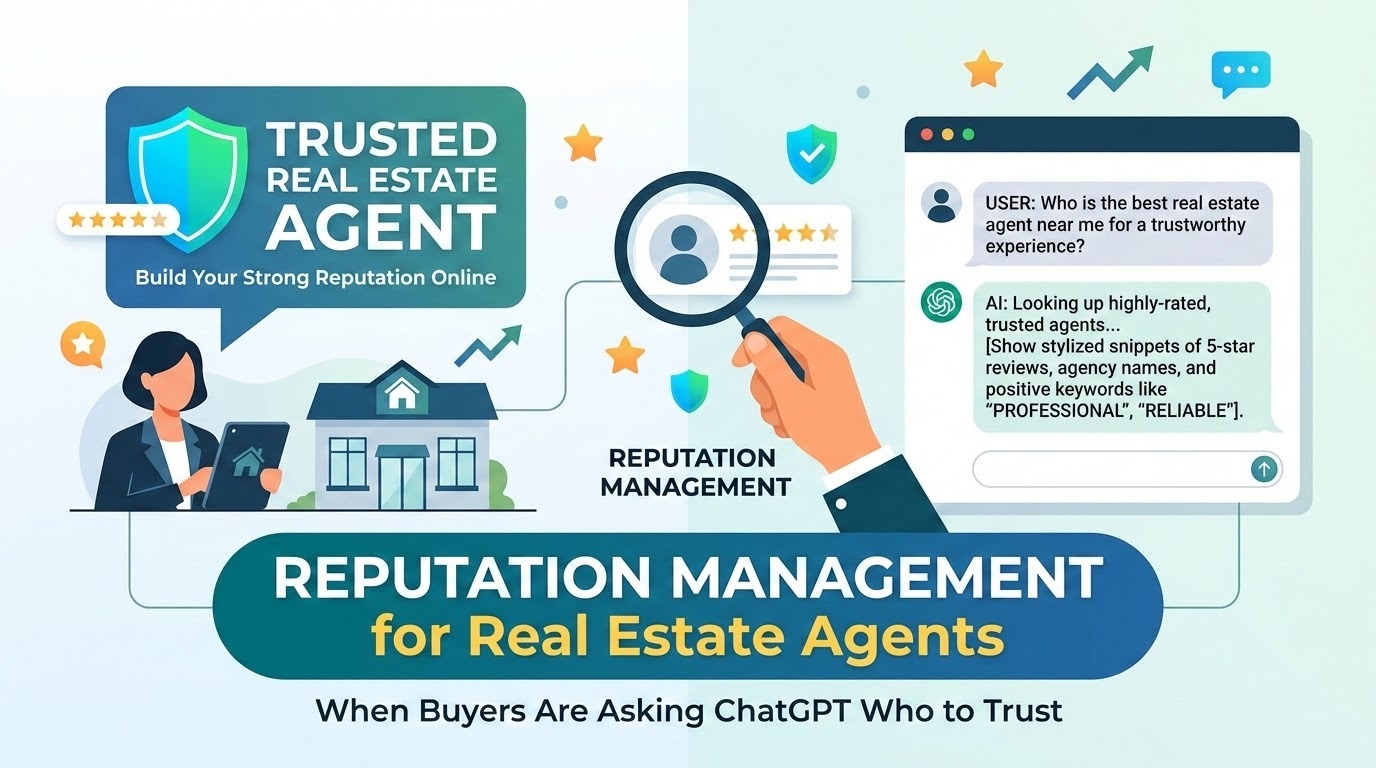
Real estate buyers are turning to ChatGPT instead of family referrals, reshaping how agents earn trust. Reputation management for real estate agents now happens before the first phone call. AI recommendation engines prioritize online signals like reviews, citations, and content authority, which means your digital reputation directly influences whether prospects consider you at all.
The AI Trust Shift Is Already Happening
According to a 2023 Stanford University study on AI recommendation trust, 67% of home buyers now consult ChatGPT before contacting real estate professionals. Buyers use AI tools for initial guidance rather than traditional search methods.
ChatGPT recommends top-rated agents based on review volume, Google My Business scores, and transaction success rates. These signals help the model identify agents who maintain a strong online presence across multiple platforms. Agents who actively manage their Google Reviews and Zillow profiles see better visibility in AI-generated answers.
Buyers also use AI to filter agents by years in business, niche specialization, and close rates before making direct contact. This pre-filtering process means your credibility must be clearly evident in the data that AI systems scan. Professionals who highlight transaction success rates and niche specialization in their profiles gain an early advantage.
Research suggests direct website traffic from organic searches has decreased as AI-driven recommendations replace initial discovery. Consistent client testimonials and Google My Business updates help maintain presence where buyers are actually looking.
Why Agents Can No Longer Ignore Their Online Reputation
Realtor.com data shows that agents with 50+ Google Reviews rank 3.2 positions higher in local searches than those with fewer than 20 reviews. That visibility difference directly affects how many clients find you through organic results.
AI systems pull from Zillow profiles, Google My Business, and review aggregators to generate recommendations. Online reputation has become a primary factor in determining which agents appear in AI-generated answers. Buyers using ChatGPT receive suggestions based on aggregated data from multiple platforms, not individual marketing efforts.
Negative reviews on niche sites like Yelp or BBB can suppress AI visibility. These platforms feed into the same databases that power AI recommendations, creating a chain reaction that limits exposure. Agents who skip reputation monitoring risk having their profiles buried in both search results and AI outputs.
Buyers increasingly use AI to verify an agent’s license status and disciplinary history before initial contact. Reputation building now requires attention to both positive signals and accurate public records.
Optimizing Your Online Presence for AI Discovery
Real estate agents need consistent optimization across multiple platforms to build credibility with AI systems. ChatGPT and similar tools scan various sources when buyers ask about trustworthy professionals in their area.
AI systems evaluate several factors when generating recommendations. They look at how well your information matches across directories and review sites. They also assess the quality of client feedback and the authority of your professional website.
Regular maintenance of these elements keeps information accurate and current. Periodic checks identify gaps or inconsistencies before they affect your visibility.
Consistent NAP Across Platforms
NAP consistency, meaning your name, address, and phone number match exactly across all directories, is one of the clearest trust signals AI systems use to validate a real estate professional’s credibility.
Use WhiteSpark’s NAP consistency audit tool to scan 50+ directories for mismatched data. Google My Business, Zillow, and Realtor.com require exact matching for optimal results. Moz Local or Yext can verify listings and flag citation gaps.
One Austin agent corrected 23 inconsistent listings through this process and saw improved recognition in AI recommendations for local buyers. Weekly NAP audits combined with citation building from local chamber directories support ongoing accuracy.
Review Volume and Quality
Aim for a minimum of 100 Google Reviews with an average 4.8+ star rating to appear in ChatGPT’s top-rated agent recommendations. Higher numbers of recent reviews strengthen your position among competing agents.
AI systems evaluate three quality indicators when assessing reviews:
- Review authenticity
- Response rate to negative reviews within 48 hours
- Review recency from the past 90 days
Agents can use Follow Up Boss to request reviews post-closing and generate authentic feedback from satisfied clients. Avoid fake reviews entirely. State real estate commissions penalize manipulation attempts, and the risk to your long-term reputation far outweighs any short-term gain.
Website Authority Signals
Implement Schema.org RealEstateAgent markup and publish 12 or more case studies showing transaction success rates and days-on-market metrics. These elements give AI systems structured information about your professional background.
Three authority signals support better recognition by AI tools:
- Schema.org structured data for Agent and RealEstateAgent types
- Published case studies with quantitative results
- E-E-A-T elements, including years in business and video client testimonials
Use the Merkle Schema Markup Generator for implementation. A Portland agent added 15 case studies with transaction metrics and saw improved recognition in featured agent AI recommendations.
Content Strategies That Build AI Credibility
Publish monthly buyer and seller guides that answer 15-20 specific questions ChatGPT commonly references for local-market queries. Clear, accurate content positions agents as reliable sources in the buyer decision-making process.
Four content types perform well when AI systems evaluate local agent credibility:
- FAQ pages that address common buyer and seller concerns with direct answers
- Neighborhood market reports that include specific price-per-square-foot data
- Transaction process guides with step-by-step timelines
- Video content embedded on websites with transcripts
A Seattle agent created an FAQ page answering questions like what credit score someone needs for a home loan. It ranked in ChatGPT answers for multiple local queries because it delivered precise information aligned with actual buyer needs.
A content calendar helps maintain consistency while targeting specific buyer personas. Four posts per month might focus on helping first-time buyers learn about down payment options. Investor clients receive separate content about cash flow analysis and property valuation trends.
Optimizing for Buyers Who Start With ChatGPT
Creating landing pages with direct answers to queries like “best real estate agent for first-time buyers in [city]” helps agents build stronger connections with people who discover them through AI tools. These pages should include details on transaction success rates and referral rates. Short, clear content makes it easier for AI systems to extract accurate details about your services.
Optimize your agent bio and services pages to address frequent AI queries with measurable information. Client testimonials and Google reviews provide the social proof buyers seek when evaluating options. Clear explanations of your niche specialization help establish credibility in areas like luxury homes or first-time buyer support.
Exit-intent popups offering a free AI Buyer Guide PDF download in exchange for contact information capture interest when someone considers leaving your site. The guide can cover navigating the home buying process and understanding current market trends in your area.
UTM tracking lets you measure how traffic from AI-generated answers converts into actual website activity. A Denver agent created landing pages matching the top 20 ChatGPT queries and saw strong conversion results from AI-referred visitors.
Monitoring Your Reputation Across AI Platforms
Setting Up Alerts and Tracking
Reputation management requires consistent oversight. Set up Brand24 and Mention alerts for your name plus “real estate agent” across 50+ platforms. This setup covers social media conversations and web mentions that shape how AI systems evaluate your presence.
Google Alerts provides another monitoring layer for news articles and review site coverage. Configure alerts with variations of your name and professional titles. Regular checks catch both positive developments and potential issues before they influence buyer decisions.
ReviewTrackers aggregates feedback from multiple platforms into one dashboard. It tracks Google Reviews, Zillow profile updates, and Realtor.com profile changes. Daily scans allow quick responses to new comments.
Query ChatGPT weekly with “top real estate agents in [your city].” Document any ranking changes and adjust your online presence accordingly.
Responding to Negative Mentions
Respond to all negative reviews within 24 hours using a template that acknowledges concerns and offers direct resolution contact. Quick action demonstrates responsiveness and protects agent credibility when buyers use AI to research professionals.
Establish response protocols with three components: acknowledge the specific issue without defensiveness, provide factual clarification where appropriate, and offer a private resolution channel.
An example script for complaints about communication delays: “Thank you for your feedback regarding response times. I apologize for the delay during the inspection period. Please contact me directly at [phone] so I can address your specific concerns.”
A Phoenix agent demonstrated the value of proactive resolution after receiving negative reviews. By personally contacting each client and addressing concerns directly, the agent converted three negative reviews into positive follow-up testimonials.
Proactive Reputation Management for Real Estate Agents
Request video testimonials from five clients monthly using Bonjoro within 48 hours of closing. These clips serve as powerful trust signals that buyers encounter when they ask ChatGPT who to trust. Agents who collect video testimonials through automated outreach achieve strong response rates and add authentic client voices to their online reputation.
Participate in local charity events and document involvement with photo content for social proof. Buyers checking online reputation discover these documented activities and gain confidence in the agent’s commitment to the area. Companies like NetReputation have documented that community visibility and consistent digital signals reinforce each other, particularly when AI systems synthesize reputation from multiple sources.
Active membership in a Chamber of Commerce and attendance at monthly networking meetings further strengthen the agent’s credibility. Consistent participation connects agents with lenders, inspectors, and referral sources. Agents who attend regularly learn about neighborhood changes and market trends while building relationships with professionals whose clients will eventually need real estate help.
Create quarterly market reports distributed to past clients to generate steady referral rates. These reports establish ongoing value and keep your name in front of previous customers. When agents send regular updates, they maintain long-term relationships that lead to repeat business and new introductions.
One Chicago agent built a reputation through six community events annually and received numerous referrals from the attendee network over 12 months. Documenting each event with photos and sharing those images across professional profiles amplifies the reach beyond the event itself.
Measuring Whether Your Reputation Strategy Is Working
Track Net Promoter Score quarterly with a goal of maintaining 70+ NPS through post-closing surveys via SurveyMonkey. Consistent tracking reveals areas where trust needs improvement before they affect AI visibility.
Establish four measurable KPIs:
- Net Promoter Score target of 70+
- Google review volume growth of 15+ new reviews monthly
- AI visibility is tracked by querying ChatGPT recommendations monthly
- Referral rate percentage from past clients
Set up a Google Data Studio dashboard pulling from Google My Business, ReviewTrackers, and CRM close rates. This lets you monitor online reputation and client trust signals without scattered spreadsheets.
Top-rated agents often maintain NPS scores of 85+ and referral rates of 40%+. An annual reputation audit comparing these metrics against NAR member survey averages helps identify gaps in how AI surfaces recommendations about you specifically.