Dutch Colonial House: History, Plans, Characteristics & Styles

The Dutch Colonial house is one of America’s most enduring architectural styles — instantly recognizable by its gambrel roofline, flared eaves, and charming dormer windows. Rooted in 17th-century Dutch settler communities along the Hudson Valley, this style has shaped neighborhoods across the Northeast for over three centuries.
Whether you are searching for Dutch Colonial house plans, browsing homes for sale, or simply curious about the style, every detail of these homes reflects a unique blend of European heritage and American practicality. Explore more iconic American residential styles at MansionFreak, where architecture and legacy come together.
Quick Facts: Dutch Colonial House at a Glance
| Feature | Detail |
| 🏠 Style | Dutch Colonial / Colonial Revival |
| 📍 Historic Concentration | Hudson Valley NY, Northern NJ, CT, PA |
| 🏗️ Defining Feature | Gambrel roof with flared eaves |
| 📐 Typical Size Range | 1,000 – 3,500+ sq ft |
| 🛏️ Common Layout | 3–5 bedrooms, 1.5–3 bathrooms |
| 🪵 Traditional Materials | Fieldstone, brick, wood clapboard, cedar shingle |
| 📅 Peak Popularity | 17th-century origins; Colonial Revival 1890–1940 |
| 💰 Current Market Range | $350,000 – $3.5 million (location dependent) |
Dutch Colonial House History
The Dutch Colonial house traces its roots to the 17th century, when Dutch settlers brought their building traditions to the Hudson Valley in present-day New York and New Jersey. Their preference for brick, stone, and steep rooflines — engineered for heavy rain and snow — laid the foundation for a distinct American style that has outlasted nearly every other colonial form.

The Gambrel Roof Takes Shape
By the mid-1700s, the gambrel roof had become the style’s defining feature. Its double-pitched design — steep lower slope, shallow upper slope — maximized attic storage on a modest footprint, a practical necessity for colonial farming families who needed every square foot they could get.
The Colonial Revival Resurgence
The late 19th and early 20th centuries brought a wave of renewed interest. Entire suburban neighborhoods across New Jersey, Pennsylvania, Connecticut, and New York were built with gambrel-roofed homes during this period, many of which remain in excellent condition today and continue to command strong resale values.
Dutch Colonial House Characteristics
A Dutch Colonial house is defined by a consistent set of architectural signatures that appear across centuries and regions:

- Gambrel roof with a steep lower pitch (near 60°) and a shallower upper pitch (near 30°)
- Flared or curved eaves that extend beyond the wall plane, sheltering entryways and porches
- Shed, gabled, or eyebrow dormers that punctuate the roofline and light the upper floor
- Symmetrical facade with a centered front door — traditionally a divided Dutch door
- Durable exteriors in fieldstone, brick, painted clapboard, or cedar shingle
Dutch Colonial House Plans
Dutch Colonial house plans are engineered around the gambrel roof’s spatial advantage — the upper story gains far more usable floor area than a standard gable roof allows at the same wall height. This practical geometry is what made the style so popular with working families across three centuries.

Common Floor Plan Layouts
Dutch Colonial house floor plans typically fall into three configurations:
- Two-story layouts with living areas on the ground floor and bedrooms filling the full upper story
- Cape-style variants with a partially finished upper floor lit by dormers
- Side-entry designs where the main entrance sits on the long elevation, creating a horizontal street presence
Plans range from 1,200 sq ft for modest cape-style homes to over 3,000 sq ft for larger Revival-era examples. Many architectural firms and online plan services now offer both historic reproductions and updated interpretations with contemporary open-plan interiors.
Dutch Colonial House Features: A Room-by-Room Look
Exterior & Roofline
The gambrel roofline is the immediate identifying marker from any distance. Wide flared eaves create strong horizontal shadow lines at ground level, while shed dormers spanning much of the roof length give the upper floor a bold, inhabitable presence. The overall silhouette reads cleanly in every season.
Interior Living Spaces
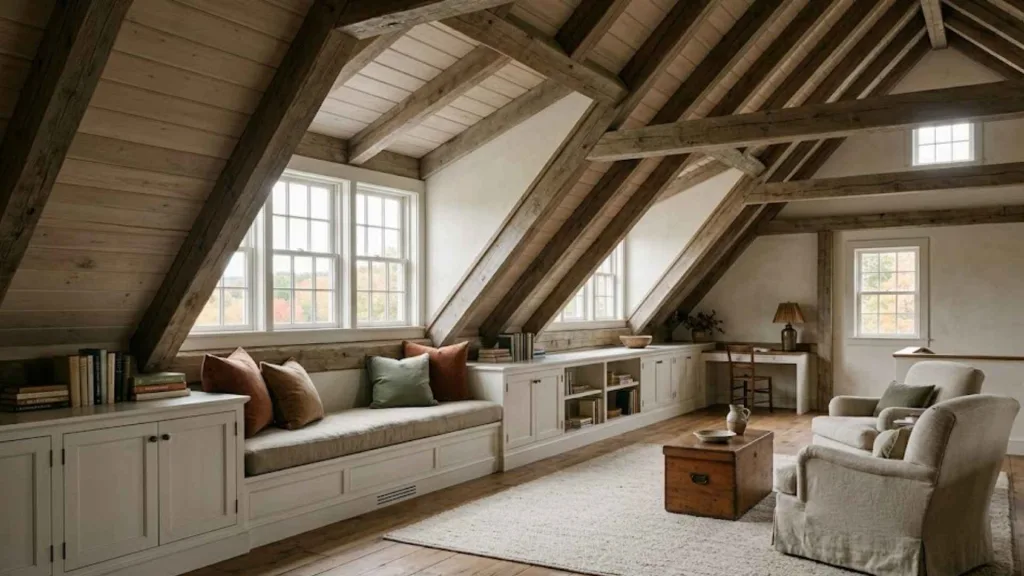
Upper-floor rooms feel open and airy beneath the gambrel’s generous pitch. Knee-wall spaces along the eaves serve perfectly as built-in storage or window seats — a practical feature rooted in the original colonial design philosophy of squeezing maximum use from every corner.
Kitchen & Gathering Areas
Traditional kitchens featured exposed wooden ceiling beams, wide-plank hardwood floors, and fireplace surrounds with blue-and-white Delft tile insets. Contemporary renovations typically preserve these period details while opening up the kitchen and living areas to suit modern, open-plan family life.

Fireplace & Period Details
Fireplaces were central to Dutch Colonial homes, both structurally and socially. Delft tile surrounds, wide-plank floors in oak, chestnut, or pine, and divided-light windows with small colonial grid panes remain the most sought-after original details in today’s resale market.
Gambrel Roof
The gambrel roof is the style’s unmistakable signature. Its two-pitched design creates generous upper-floor volume without raising wall height — a structural solution that doubles as a visual landmark visible from any approach.
Flared Eaves
Wide eaves curve outward at the base of the roofline, creating a sheltering overhang above entryways and porches. This detail gives the Dutch Colonial its characteristic “spread wings” silhouette and provides genuine weather protection.
Dormer Windows
Shed or gabled dormers punch through the roofline to deliver natural light and ventilation to upper-floor rooms. They also add visual rhythm to an otherwise unbroken roof surface and signal the habitable space within.

Dutch Door
The traditional divided Dutch door — split horizontally so the top half can open independently — is both a functional and symbolic detail. It controlled airflow and kept animals out while remaining a welcoming entry point for guests.
Fieldstone or Brick Exterior
Original Dutch Colonial homes used locally sourced fieldstone and brick, materials built to last centuries. These durable facades require minimal maintenance and develop a rich patina over time that no synthetic material can replicate.
Dutch Colonial House Interior
The interior of a Dutch Colonial house immediately reveals the gambrel roof’s generosity — upper-floor rooms feel open and airy, with knee-wall spaces along the eaves perfect for built-in storage or window seats.

Traditional interior details include:
- Exposed wooden ceiling beams on the ground floor
- Wide-plank hardwood floors in oak, chestnut, or pine
- Fireplace surrounds with blue-and-white Delft tile insets
- Built-in cabinetry tucked into upper-floor knee-wall spaces
- Divided-light windows with small panes in Colonial grid arrangements
Contemporary renovations typically preserve these original details while opening up kitchens and living areas to suit modern family life.
Dutch Colonial House Exterior
The Dutch Colonial house exterior is among the most photogenic in American residential architecture. Its strong geometric silhouette reads clearly in every season — crisp against winter skies, lush beneath summer plantings.

Key exterior features include:
- The gambrel roofline — the immediate identifying marker from any distance
- Wide flared eaves creating strong horizontal shadow lines at ground level
- Shed dormers spanning much of the roof length for a bold upper-floor presence
- Material combinations of painted wood siding, cedar shingle, brick, or stone with contrasting trim
- Covered front stoops with simple Colonial columns flanking the front door
Small Dutch Colonial House
A small Dutch Colonial house — typically 1,000 to 1,800 sq ft — retains every hallmark of the style on a standard residential lot. These compact examples are common in East Coast suburbs developed between 1900 and 1940, where builders delivered well-crafted homes for working and middle-class families.
A compact gambrel roof, a single shed dormer, simple clapboard siding, and a covered front entry are enough to express the full character of the style. Small examples remain popular with buyers who want historic charm with manageable maintenance. For more perspective on modest but iconic American homes, see Warren Buffett’s Omaha house and Jimmy Carter’s Plains, Georgia home — both celebrated for their simplicity and lasting character.
Modern Dutch Colonial House
The modern Dutch Colonial house preserves the gambrel silhouette while stripping away historic ornamentation. Architects working in this vein simplify materials, open up floor plans, and introduce contemporary finishes while keeping the roofline that makes the style unmistakable.

Modern interpretations typically feature:
- Dark or monochromatic exteriors — charcoal, navy, or black — that give the gambrel form a bold graphic quality
- Large fixed windows replacing traditional divided-light sash units
- Open-plan ground floors with flowing kitchen, dining, and living spaces
- Minimalist interiors with smooth plaster walls and exposed structural elements
- Sustainable materials including fiber cement siding, reclaimed wood, and metal roofing
The modern interpretation is especially popular in the Pacific Northwest, New England, and the upper Midwest.
Dutch Colonial House vs. Other Colonial Styles
Understanding where the Dutch Colonial sits among America’s colonial revival styles helps buyers and enthusiasts make informed comparisons.
| Style | Defining Roof | Key Region | Era |
| Dutch Colonial | Gambrel with flared eaves | Hudson Valley, NJ, CT | 17th c. / 1890–1940 |
| Colonial Revival | Gable or hip roof | New England, Mid-Atlantic | 1880–1955 |
| Georgian Colonial | Hip roof, formal symmetry | East Coast cities | 1700–1780 |
| Cape Cod | Low gable, dormers | New England | 17th c. / 1930–1950 |
The Dutch Colonial’s gambrel roof is its clearest differentiator — no other American colonial form uses this double-pitched structure as its primary design element.
Dutch Colonial House for Sale
The market for a Dutch Colonial house for sale is consistently active in states with deep historic roots — New York, New Jersey, Connecticut, Pennsylvania, and Massachusetts. Key resale markets include Ridgewood NJ, Bronxville NY, Greenwich CT, and Chestnut Hill MA.
| Property Type | Location | Price Range |
| Small Revival-era (1,200–1,800 sq ft) | Suburban NJ/PA | $350,000 – $650,000 |
| Mid-size Revival-era (2,000–2,800 sq ft) | Westchester/Fairfield County | $700,000 – $1.5M |
| Large historic or architect-designed | Hudson Valley NY | $1.2M – $3.5M |
| New construction modern version | Northeast/Pacific NW | $800,000 – $2.5M |
Buyers should inspect the gambrel roof carefully — the transition between its two pitches is the most common point of water infiltration if flashing fails. Original floors, windows, and tile fireplaces add meaningful value worth preserving. Browse more notable American properties at MansionFreak’s celebrity homes section.
Dutch Colonial House Renovation Tips
Restoring or updating a Dutch Colonial requires balancing period authenticity with modern livability. These homes reward careful stewardship.
- Preserve the gambrel roofline — any structural modification to the roof pitch destroys the style’s defining character and reduces resale value
- Maintain original materials where possible — fieldstone, brick, and wide-plank floors are irreplaceable and central to the home’s appeal
- Upgrade mechanicals invisibly — route modern HVAC and electrical within existing wall cavities to avoid disrupting original finishes
- Restore rather than replace windows — original divided-light sash units can be weatherstripped and reglazed at a fraction of replacement cost while preserving historic integrity
What Makes the Dutch Colonial House Genuinely Special?
The Dutch Colonial house endures because it solves a real architectural problem — maximizing livable space within a modest structure — with a solution that is also visually compelling. Its gambrel roof is not a decorative choice; it is an engineering response to how families actually lived. Wide eaves suggest shelter.
Dormers signal inhabited upper floors. Durable materials reflect a commitment to building things that last. Three centuries after the first Dutch settlers broke ground along the Hudson, well-preserved examples still command premium prices — and earn them.
Frequently Asked Questions
Where are Dutch Colonial houses most common?
New York, New Jersey, Connecticut, Pennsylvania, and Massachusetts — particularly the Hudson Valley, northern New Jersey suburbs, and Fairfield County, Connecticut.
Are Dutch Colonial house plans available for new builds?
Yes. Architectural firms and online plan services offer both historic reproductions and modern open-plan interpretations, from compact cape layouts to larger two-story designs.
How much does a Dutch Colonial house cost?
Prices range from approximately $350,000 for a modest suburban example to over $3 million for a large, historically significant property in premium Northeast markets.
How does the Dutch Colonial differ from other colonial styles?
The gambrel roof with flared eaves is the clearest differentiator. Georgian and Federal Colonial styles use gable or hip roofs; only the Dutch Colonial uses this double-pitched form as its primary structural and visual element.