Frank Lloyd Wright Houses: His Iconic Homes Across America
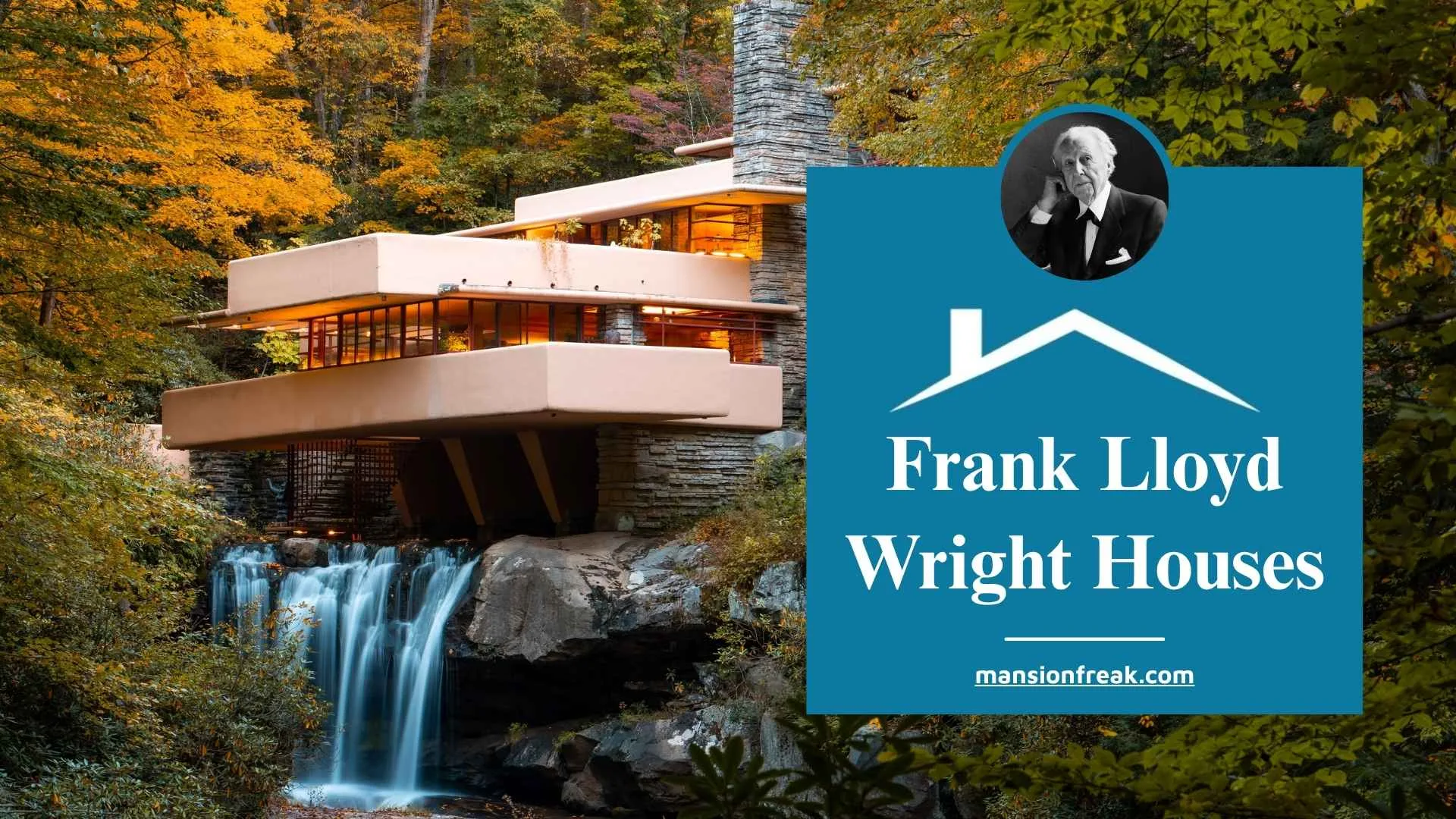
Frank Lloyd Wright’s journey from a small Wisconsin town to becoming America’s most celebrated architect is vividly reflected in the homes he designed. From the sweeping horizontal lines of Prairie-style bungalows in the Midwest to the gravity-defying cantilevered terraces of Fallingwater in Pennsylvania, each residence tells a unique chapter of his extraordinary architectural legacy.
Neverland had its zoo and amusement park — but Frank Lloyd Wright houses had something far more lasting: a philosophy of organic architecture that changed how the world thinks about space, nature, and the places we call home. Their combined value today runs into the hundreds of millions, and several are UNESCO World Heritage Sites.
Explore these iconic properties in depth at MansionFreak, where we unravel the story behind the most legendary homes ever built. It is not just about the structures — it is about the legacy they represent, one that will never fade.
Frank Lloyd Wright Houses: Quick Property Overview
| Property Detail | Information |
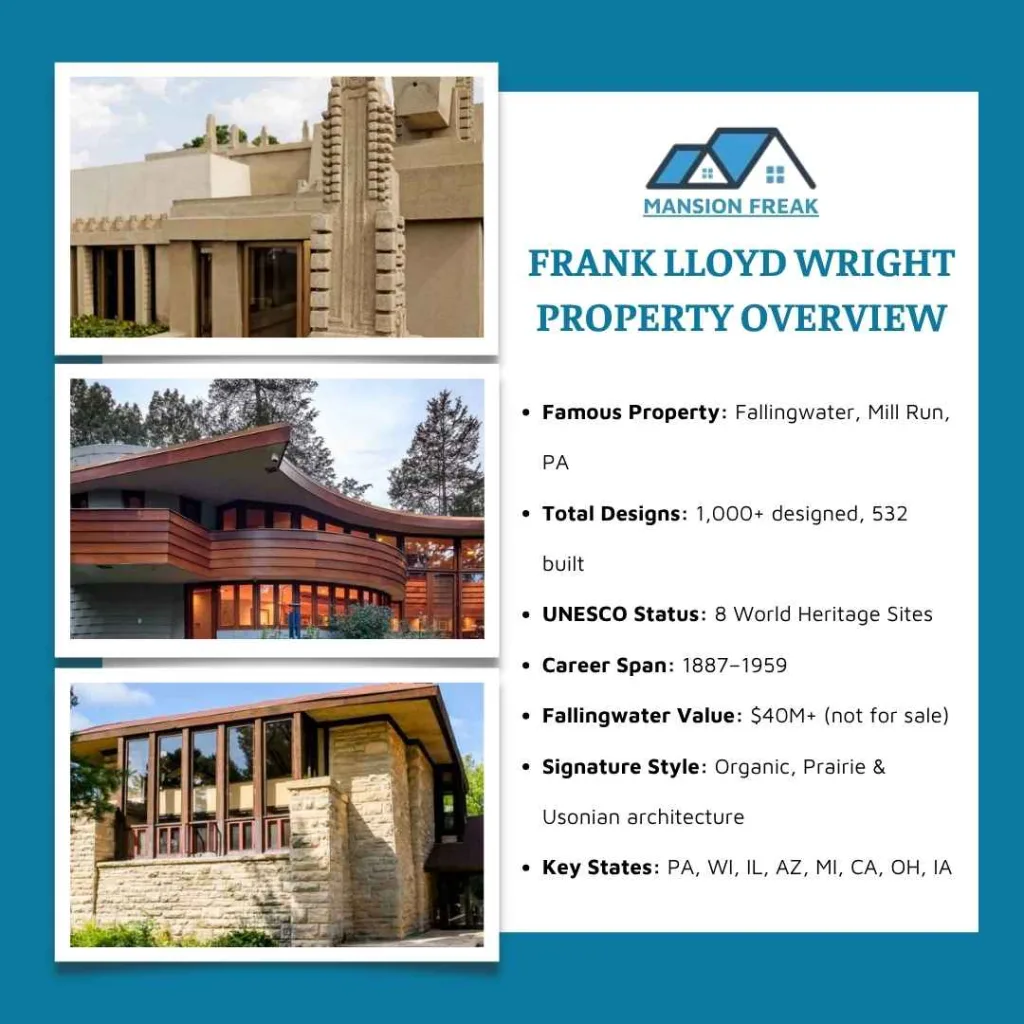
| 📍 Most Famous Property | Fallingwater, 1491 Mill Run Road, Mill Run, Pennsylvania 15464 |
| 🏠 Total Designs | Over 1,000 structures designed; approximately 532 built |
| 🌳 UNESCO Status | 8 buildings designated World Heritage Sites (2019) |
| 🏗️ Career Span | 1887 – 1959 (72 active years) |
| 💰 Fallingwater Value | Estimated $40+ million (not for sale; held by Western Pennsylvania Conservancy) |
| 🛏️ Signature Style | Organic Architecture, Prairie Style, Usonian homes |
| 🎯 Key States | Pennsylvania, Wisconsin, Illinois, Arizona, Michigan, California, Ohio, Iowa |
How Many Houses Did Frank Lloyd Wright Design?
Frank Lloyd Wright designed over 1,000 structures throughout his 72-year career, of which approximately 532 were actually built. Today, around 400 to 430 of those structures survive across 36 U.S. states. His residential work alone spans hundreds of homes — from grand Prairie-style estates in Illinois to modest Usonian bungalows built for middle-income families across the Midwest and beyond.
List of Frank Lloyd Wright Houses by State — A Geographic Overview
Wright’s work spans nearly every region of the country. Here is a concise state-by-state guide to his most significant surviving designs.
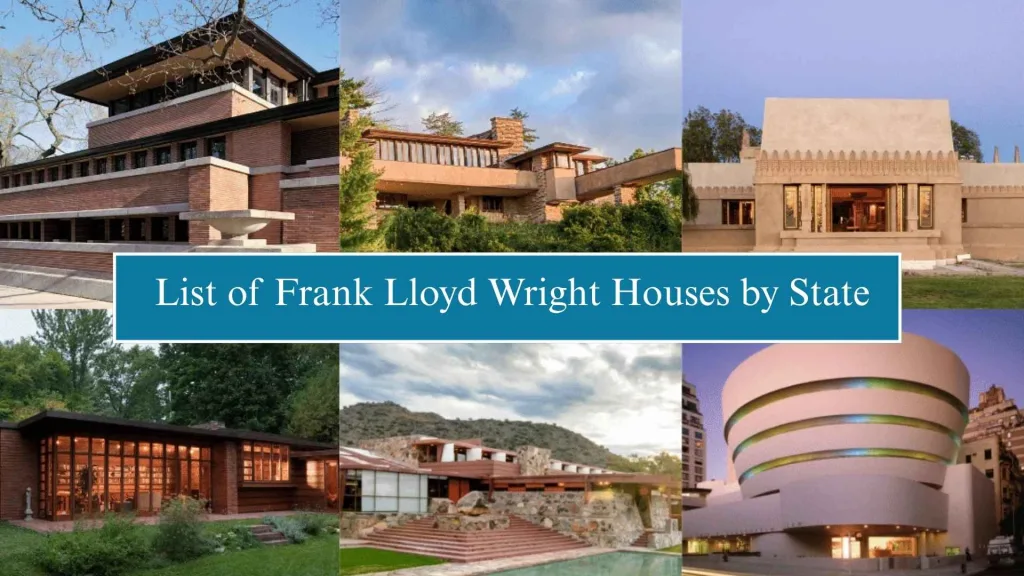
- Pennsylvania — Fallingwater (Mill Run), Kentuck Knob (Chalk Hill)
- Illinois — Robie House (Chicago), Unity Temple & Home/Studio (Oak Park), Dana-Thomas House (Springfield)
- Wisconsin — Taliesin (Spring Green), SC Johnson Building (Racine), Wingspread (Wind Point)
- Arizona — Taliesin West (Scottsdale)
- California — Hollyhock House & Ennis House (Los Angeles), Marin County Civic Center (San Rafael)
- Michigan — Affleck House (Bloomfield Hills), Palmer House (Ann Arbor)
- Ohio — Westcott House (Springfield), Weltzheimer/Johnson House (Oberlin)
- Iowa — Stockman House & Park Inn Hotel (Mason City), Delbert Meier House (Quasqueton)
- New York — Guggenheim Museum (NYC), Crimson Beech (Staten Island)
New Hampshire, Minnesota, Texas, Oklahoma, Kansas, and Virginia also contain surviving examples. The Frank Lloyd Wright Building Conservancy’s online database lists all confirmed surviving structures organized by state — the most authoritative list of Frank Lloyd Wright houses available anywhere.
Frank Lloyd Wright Houses Photos — What to Expect Visually
Every Frank Lloyd Wright house shares a set of unmistakable visual qualities that make them instantly recognizable in photographs.
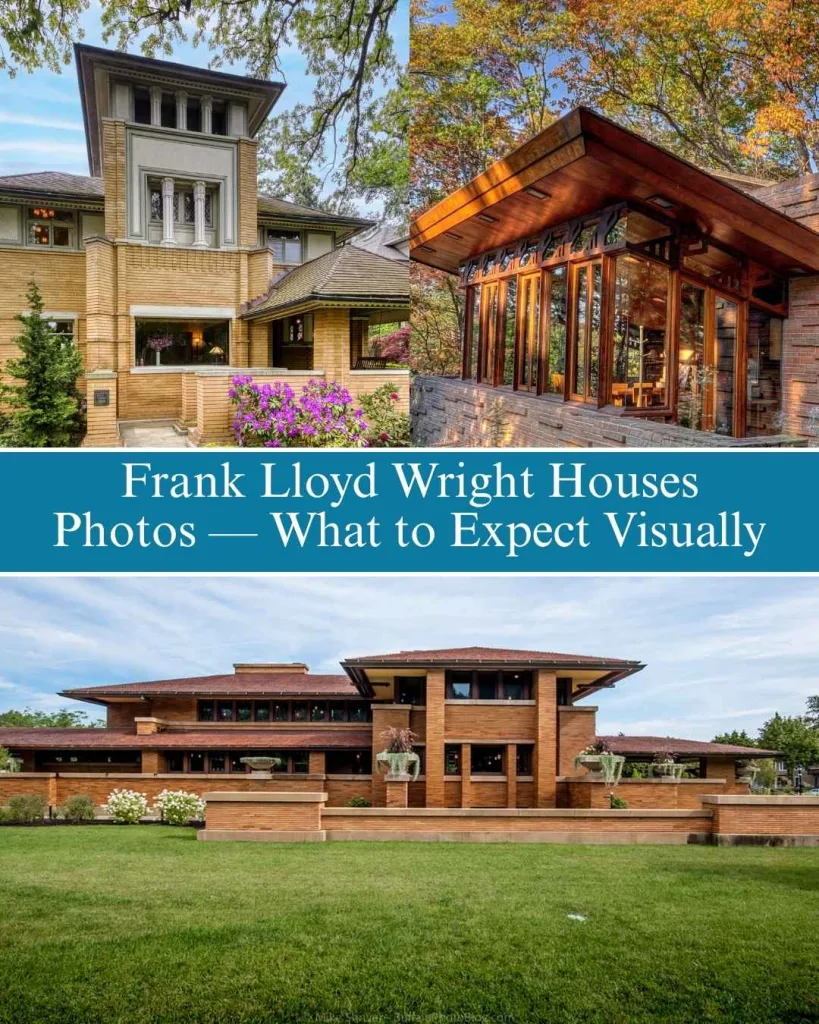
Key Design Traits
- Horizontal emphasis — low-pitched roofs and extended eaves that dissolve the boundary between indoors and landscape
- Natural materials — rough sandstone, unfinished wood, desert rubblestone; Wright rarely painted structural surfaces
- Compression and release — narrow, low entryways that open dramatically into tall, light-filled living spaces
- Geometric ornament — art glass windows, patterned tile, and custom-designed furniture unified across every interior
The Library of Congress Historic American Buildings Survey offers a free public archive of measured drawings and photographs for dozens of Wright properties.
Frank Lloyd Wright House’s Fallingwater — The Most Famous of All
Fallingwater is the most celebrated of all Frank Lloyd Wright houses — and arguably the greatest work of American architecture ever built.
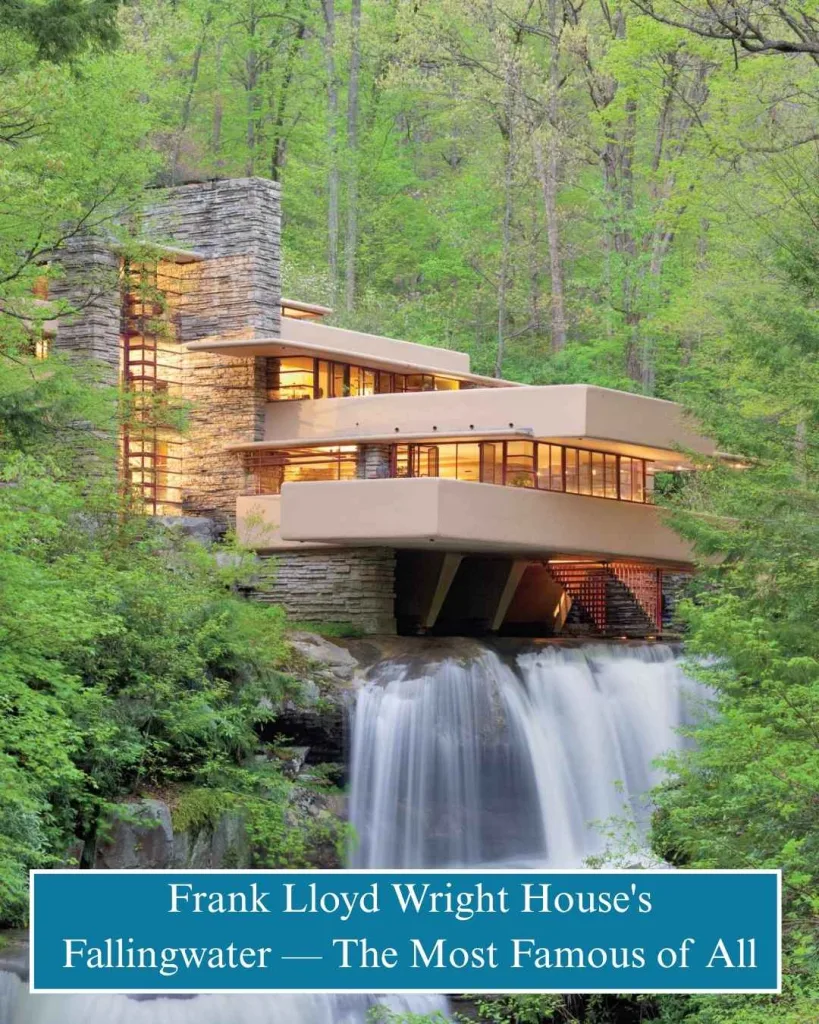
Location & Design
Built 1936–1939 for Edgar J. Kaufmann Sr., Fallingwater sits at 1491 Mill Run Road, Mill Run, Pennsylvania. Wright cantilevered its concrete terraces directly over Bear Run waterfall, using locally quarried sandstone to anchor the structure to its forested hillside.
Size & Status
- Main house: ~5,330 sq ft across three levels
- Guest house: additional 1,700 sq ft
- Donated to the Western Pennsylvania Conservancy in 1963
- Designated a UNESCO World Heritage Site in 2019
- Receives approximately 170,000 visitors annually
Frank Lloyd Wright Houses Chicago — Where the Revolution Began
Chicago’s suburbs hold the world’s highest concentration of Wright-designed structures, making it the essential starting point for any architectural tour.
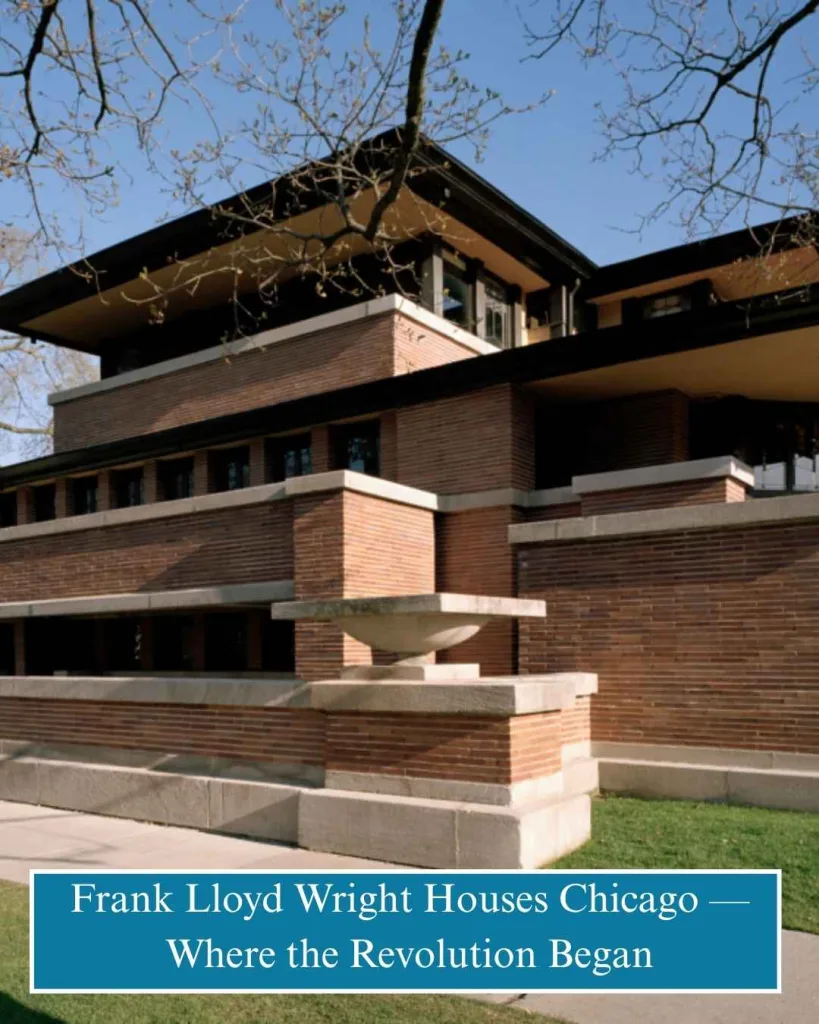
Key examples include:
- Robie House (5757 S. Woodlawn Ave, Chicago) — Built in 1910, this is considered the pinnacle of Wright’s Prairie Style. Its dramatically horizontal profile, overhanging eaves, and open interior floor plan fundamentally broke from the Victorian tradition. It is open to the public and managed by the Frank Lloyd Wright Trust.
- Unity Temple (875 Lake St, Oak Park) — Completed in 1908 and built almost entirely from poured concrete, Unity Temple is one of the eight UNESCO World Heritage Sites. It remains an active Unitarian Universalist congregation and welcomes visitors year-round.
- Charnley-Persky House (1365 N. Astor St, Chicago) — Designed while Wright was still working for Sullivan in 1891, this Gold Coast townhouse hints at what was to come.
The Frank Lloyd Wright Trust manages tours of the Home and Studio, Robie House, and several other properties across the Chicago area, making the city the single best destination for experiencing Frank Lloyd Wright houses firsthand.
Frank Lloyd Wright Houses Wisconsin — Taliesin and His Heartland Roots
Wisconsin is where Wright was born (Richland Center, 1867) and where his most personal architecture lives.
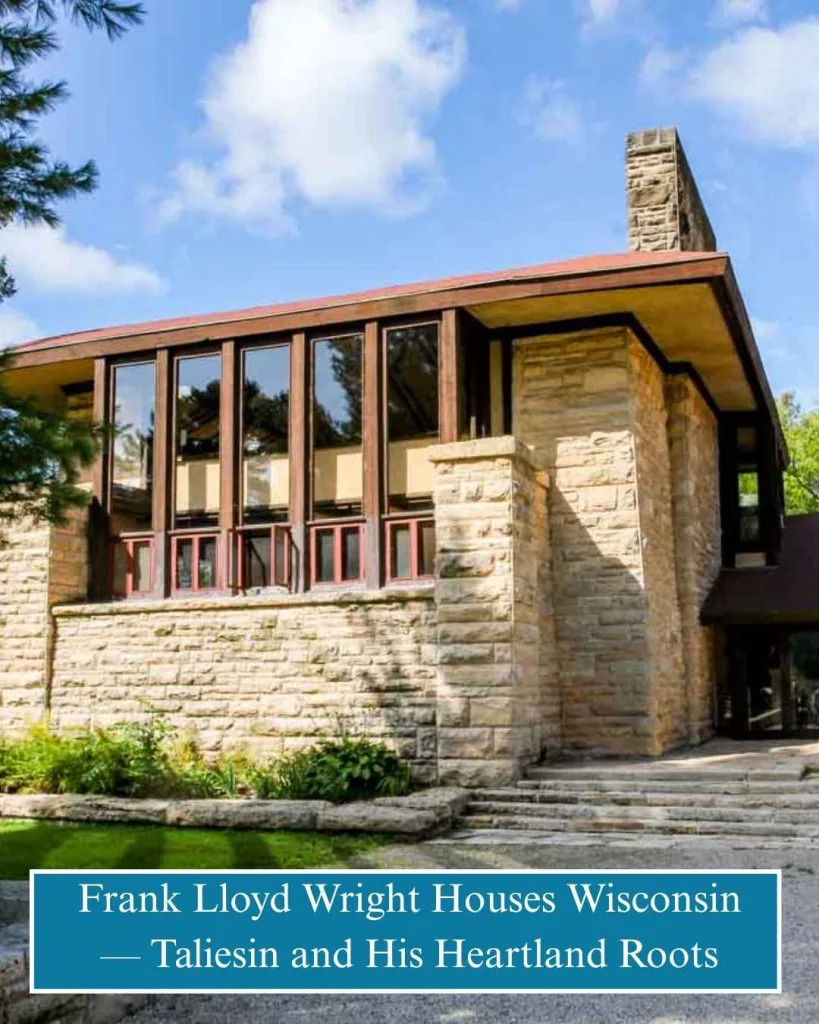
Taliesin, Spring Green
Taliesin (County Road C, Spring Green) was Wright’s primary home, studio, and school from 1911 until his death. He rebuilt it twice after devastating fires in 1914 and 1925. Today it covers ~37,000 sq ft across 600 acres, managed by the Frank Lloyd Wright Foundation with tours ranging from one hour to a full day.
Other Wisconsin highlights include the SC Johnson Wax Administration Building in Racine (1939) and Wingspread in Wind Point — both open to visitors.
Frank Lloyd Wright Houses Michigan — Usonian Homes of the Great Lakes
Michigan’s Wright collection centers on his Usonian designs — affordable, single-story homes built for middle-income families, featuring radiant floor heating, carports, and natural wood interiors.
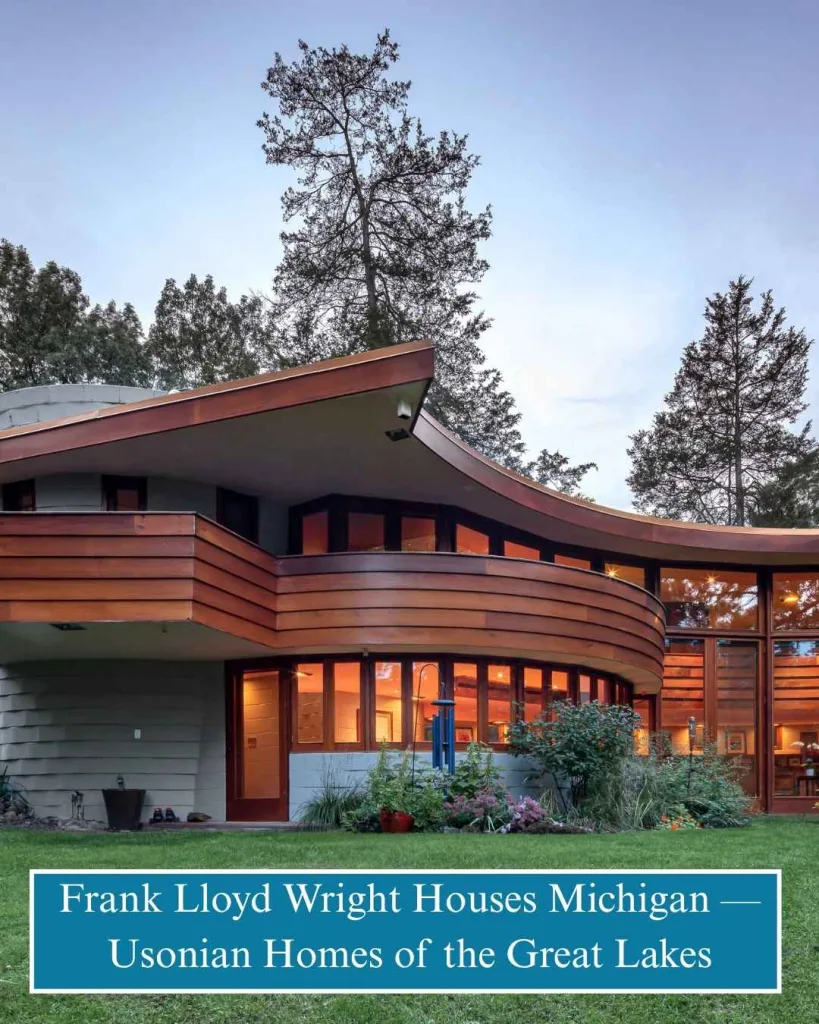
- Affleck House (1925 Ponvalley Rd, Bloomfield Hills, 1941) — owned by Lawrence Tech University; open for scheduled tours
- Palmer House (227 Orchard Hills Dr, Ann Arbor, 1952) — uses triangular module planning rather than the standard rectangular grid
- Schaberg House (Okemos, 1950) — privately owned; featured in regional architectural tours
Frank Lloyd Wright Houses Los Angeles — The Concrete Textile Block Experiments
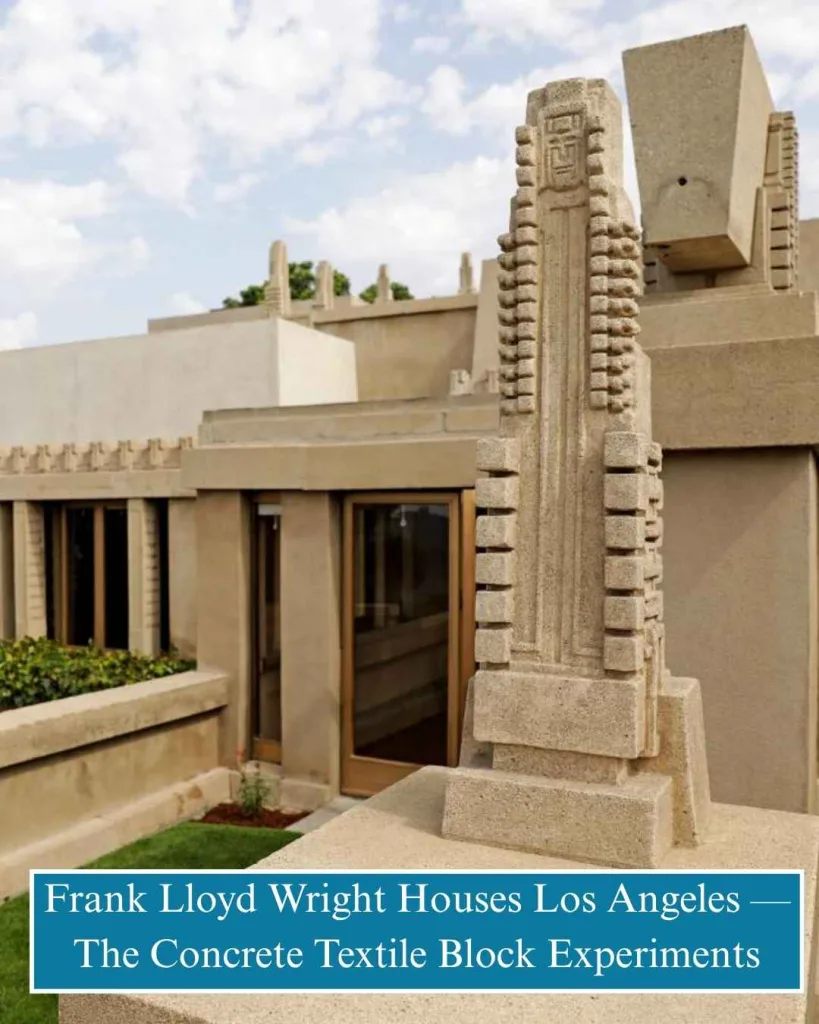
Los Angeles holds Wright’s most visually dramatic residential designs, built in the 1920s using his textile block system — interlocking precast concrete units stamped with geometric patterns.
Key LA Properties
- Hollyhock House — 4800 Hollywood Blvd; built 1919–1921 for oil heiress Aline Barnsdall. Donated to the City of Los Angeles, designated a UNESCO World Heritage Site in 2019, and open for public tours.
- Ennis House — 2607 Glendower Ave, Los Feliz; built 1924. The largest textile block home Wright ever designed, with a Mayan-influenced silhouette that has appeared in Blade Runner and dozens of other films. Privately owned.
- Freeman House — 1962 Glencoe Way, Hollywood Hills; built 1924. Now owned by USC and under long-term restoration.
Frank Lloyd Wright Houses Ohio — Underrated Midwestern Masterpieces
Ohio’s Frank Lloyd Wright houses are less publicized than those in Illinois or Pennsylvania, but they reward visitors enormously.
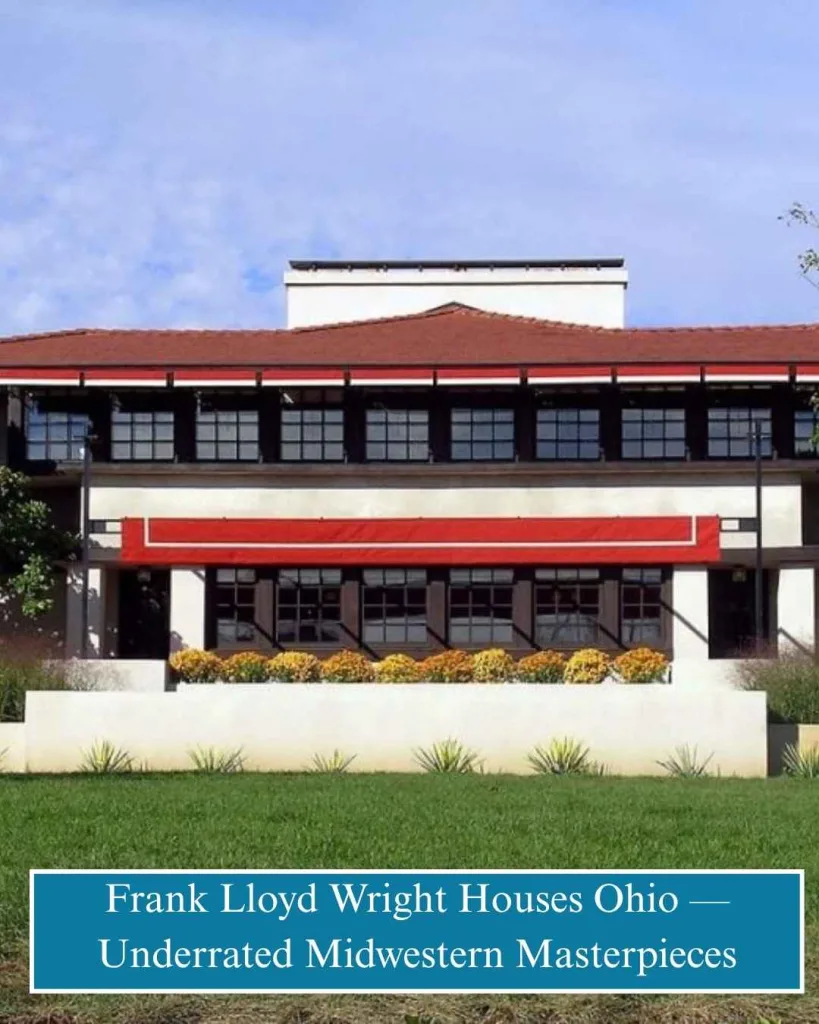
Westcott House, Springfield
Built in 1908 at 1340 E. High Street, this is Ohio’s only Prairie-style Wright home. It fell into severe disrepair before a $4.2 million restoration (2003–2005) returned it to its original condition. It is now open to the public and considered one of the finest preservation success stories in American architecture.
Weltzheimer/Johnson House (Oberlin College, 1948) — a Usonian home that retains most of Wright’s original built-in furniture; periodically open to visitors.
Frank Lloyd Wright Houses Iowa — Prairie Gems on the Plains
Iowa holds a quietly impressive Wright collection, centered in Mason City and the surrounding rural landscape.
- Stockman House (530 1st St NE, Mason City, 1908) — one of the earliest surviving Prairie homes open to the public; managed as a museum
- Park Inn Hotel (4–12 W. State St, Mason City, 1910) — the last remaining hotel designed by Wright anywhere in the world; fully restored in 2011 for $20 million; guests can book a room and sleep inside a Wright original
- Delbert Meier House (Quasqueton, 1950) — a rural Usonian farm residence occasionally open for tours
Frank Lloyd Wright Houses in Arizona — Desert Mastery at Taliesin West
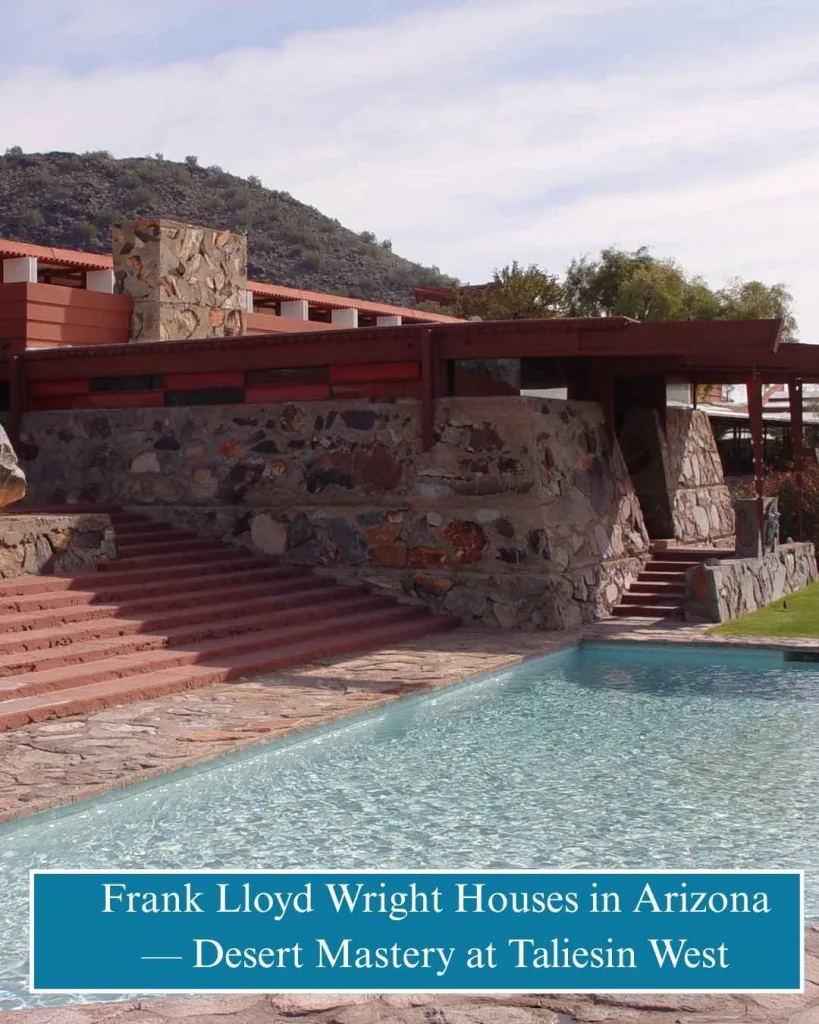
Arizona is home to Wright’s winter headquarters and the definitive expression of his desert philosophy.
Taliesin West, Scottsdale
Located at 12621 Frank Lloyd Wright Blvd, Scottsdale, AZ 85259, Taliesin West was begun in 1937 when Wright was 70 years old. Using desert rubblestone embedded in concrete, canvas roof panels stretched over redwood frames, and wide terraces angled toward the McDowell Mountains, Wright created a complex that feels simultaneously ancient and radical.
Similar to how fans visit Forrest Frank’s house to connect with a creative figure’s personal world, Taliesin West offers the closest possible encounter with Wright’s daily life and design thinking. Like visiting the Jimmy Carter House for its historical resonance, stepping into Taliesin West is a direct encounter with American history.
Frank Lloyd Wright Houses for Sale — What Buyers Need to Know
The short answer is: rarely, and never cheaply. Frank Lloyd Wright-designed homes trade infrequently, and when they do appear on the market, they attract global attention. In recent years, a handful of Usonian homes — Wright’s line of affordable, single-story residences designed for middle-class American families — have sold in the $500,000 to $2 million range depending on condition and location.
Notable recent sales and listings have included:
- The Crimson Beech (Staten Island, NY) — Wright’s only New York City home, sold in 2021 for $1.65 million after years of restoration work.
- The Kalil House (Manchester, NH) — A 1955 Usonian Automatic home, listed periodically in the $700,000–$900,000 range.
- The Haynes House (Fort Wayne, IN) — A 1951 Usonian design that sold for under $1 million.
Buyers should monitor the Frank Lloyd Wright Building Conservancy, which alerts members when properties come to market. Restoration costs can match or exceed the purchase price. For more landmark homes and their market histories, visit the MansionFreak celebrity homes page.
Frank Lloyd Wright’s Lasting Legacy
Frank Lloyd Wright’s influence on how Americans live is almost impossible to overstate.
- He invented the open floor plan — now standard in every new home built in America
- He pioneered radiant floor heating, carport design, and natural material interiors
- His 8 UNESCO World Heritage Sites collectively draw millions of visitors per year
- Fallingwater alone generates an estimated $70 million annually for Pennsylvania’s tourism economy
Wright died in 1959 with approximately $500,000 in debts. Today, the properties he left behind are worth hundreds of millions and anchor entire regional tourism economies.
Conclusion
The Frank Lloyd Wright houses story is ultimately a story about the relationship between human beings and the natural world. From the horizontal Prairie homes of Chicago’s suburbs to the gravity-defying terraces of Fallingwater, from the desert masonry of Taliesin West to the Usonian bungalows of Michigan and Iowa, every building Wright designed asked the same question: how should we live? The places still stand. The philosophy they embody is permanent.
Frequently Asked Questions
Where is the most famous Frank Lloyd Wright house?
Fallingwater at 1491 Mill Run Road, Mill Run, Pennsylvania, is widely considered the most famous. Built over a waterfall in 1936–1939, it is a UNESCO World Heritage Site and open for public tours.
How many Frank Lloyd Wright houses still exist?
Approximately 400–430 of his roughly 532 built structures survive today, spread across 36 U.S. states and several international locations.
Can you visit Frank Lloyd Wright houses?
Yes. Many are open for public tours, including Fallingwater (PA), Taliesin (WI), Taliesin West (AZ), Robie House and Unity Temple (IL), Hollyhock House (CA), and the Westcott House (OH), among others.
Are any Frank Lloyd Wright houses for sale?
Occasionally. Usonian homes appear on the market most frequently, typically priced between $500,000 and $2 million. The Frank Lloyd Wright Building Conservancy monitors listings.